VERSION FRANÇAISE DISPONIBLE ICI
The crushing of an instrument
The story starts in 1938 in the auditorium of a municipal cultural centre in Tokyo. A group of Japanese soldiers burst in during the quiet rehearsal by a string quartet composed of one Japanese and three Chinese musicians. The multicultural character of the group immediately arouses suspicion in a time of armed conflict between Japan and China.1
The soldiers want to know the real reason for this so-called rehearsal of Franz Schubert‘s String Quartet n° 13 opus 29. In their eyes, it is clearly a political conspiracy in the making involving three undesirable foreigners and a Japanese traitor. Fortunately, Philippe, a French journalist and friend of the musicians, has just left the rehearsal, otherwise he would have certainly added a European tint to this dubious ensemble.
From here, the tension in this opening scene of Fractured Soul builds until it reaches breaking point when the violon belonging to Yu Mizusawa, the lead musician of the quartet, is crushed beneath the boot of the most zealous of the questioning Imperial soldiers.
The arrival of a music-loving lieutenant in command of these men calms the situation slightly. He comes too late to save the violon from being damaged. However, he takes control of the interrogation and discreetly ensures the broken instrument is not left on the floor but is put safely into the darkness of a large cupboard – where the lieutenant notices, but chooses not to denounce, a young boy hiding from the soldiers and observing the scene. In fact, the boy is Yu‘s son Rei, and the lieutenant’s act in preserving the violon from further harm is crucial for the events which follow.
This is the last time Rei sees his father alive since he is arrested along with the three Chinese musicians. The child finds himself alone, and the violin becomes the expression of the protagonists’ fractured lives.
The story then leaps forward to Paris in 2003. What is the connection between the life of Jacques, the meticulous ageing luthier, and the incident from 1938 which hardly anyone now remembers? Only a full reading of the book can answer that.
A story of rupture and repair
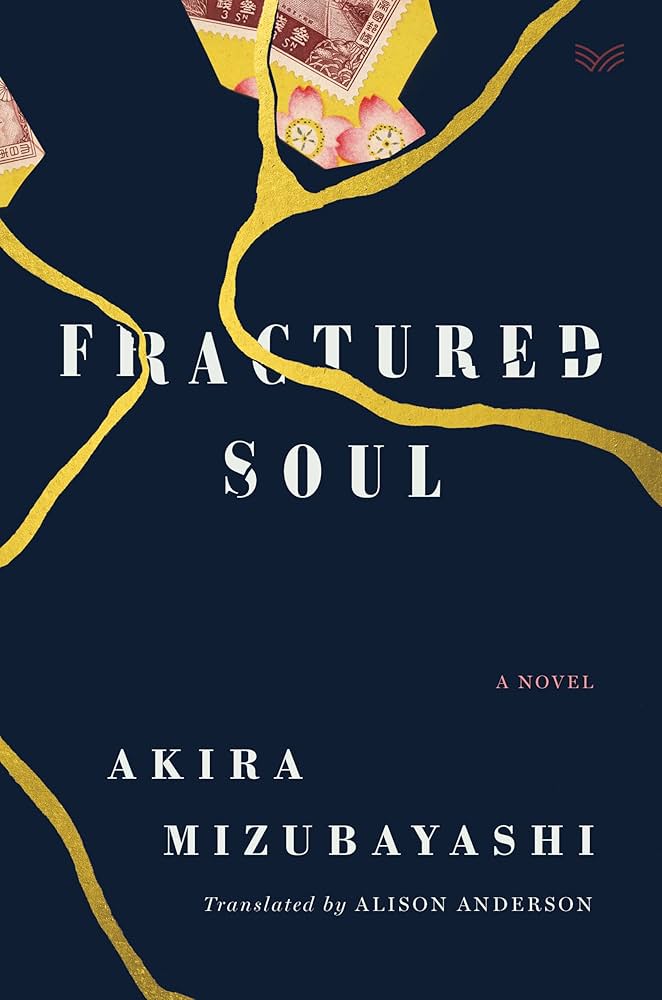
I read Fractured Soul by Akira Mizubayashi in French, thinking had been translated from the Japanese. The prose read so well that I looked to see who the translator was, but no name was credited. How strange. A French Wikipedia page clarified the situation : Mizubayashi is a Japanese author who lives and works in Japan and writes in Japanese and in French.
There’s more. I not only assumed a Japanese author would need a translator to be read in French, but also that, because the story was Japanese, it would necessarily be one of those strange tales about a forgotten floating world which I somehow associate with Japanese narrative.2 This just shows how mistaken we can all be in our representations of foreign cultures. In fact, I discovered a story of rupture and repair which echoed current events. After all, those Japanese soldiers in 1938, who come in shouting and intimidating before they fully understand the situation, could have been ICE at work today.3 And repair can be a long, painstaking process.
A challenging title for a translator
Finally, a word about the title. Fractured Soul is English-language translator Alison Anderson’s proposal for the French original Âme brisée. The most common English translation for âme is soul but, as an article from Asian Review of Books explains, in the world of stringed instruments, the word takes on a new meaning : “In French, âme names not only the human soul, but also (as Anderson points out in her translator’s note) a very specific small piece of wood found in stringed instruments… a wooden peg that is in fact, in its own way, the soul of the instrument, the tiny material element that gives beauty and heart to the sound produced by the bow against the strings.”4
The usual English name for this wooden peg is the soundpost, but the use of soul in the translated title Fractured Soul foregrounds the human drama of the story while hinting at the musical connection for those who know. Translation is always the third language.
So there you have it. This new addition to Foreign Affairs is a Japanese author’s novel written in French, imagined in four movements each entitled with the musical indications from each part of Austrian composer Franz Schubert’s String Quartet n° 13. The book plays out a subtle story which constantly tests and crosses social and cultural frontiers as it tells of the long healing process set in motion following the traumatic beginning.
The novel is an exploration of the aftermath, narrating what people have to do next if they are to survive and overcome the unthinkable. As you will see, if you read the artful Fractured Soul by Akira MIzubayashi. As I hope you will.
Still want more?
A performance of Schubert’s String Quartet n° 13 opus 29 is avalable HERE.
- The story begins during the Second Sino-Japanese War 1937-45. ↩︎
- Two examples which come to mind are the short story One Arm by Yasunari Kawabata and the novel An Artist Of The Floating World by Kazuo Ishiguro. ↩︎
- ICE = US Immigration and Customs Enforcement. ↩︎
- “Fractured Soul” by Akira Mizubayashi, reviewed by Alison Fincher, Asian Review of Books, 23 May 2023. ↩︎
Discover more from GERRY THE KENNY
Subscribe to get the latest posts sent to your email.