
Lessons from a concert made for dancing
CLIQUEZ ICI POUR LA VERSION FRANCAISE
There is something unpredictable about tango which makes it capable of asking unexpected questions in apparently normal situations in a way which makes us reassess our way of being in the world. Recently, tango questioned me again.
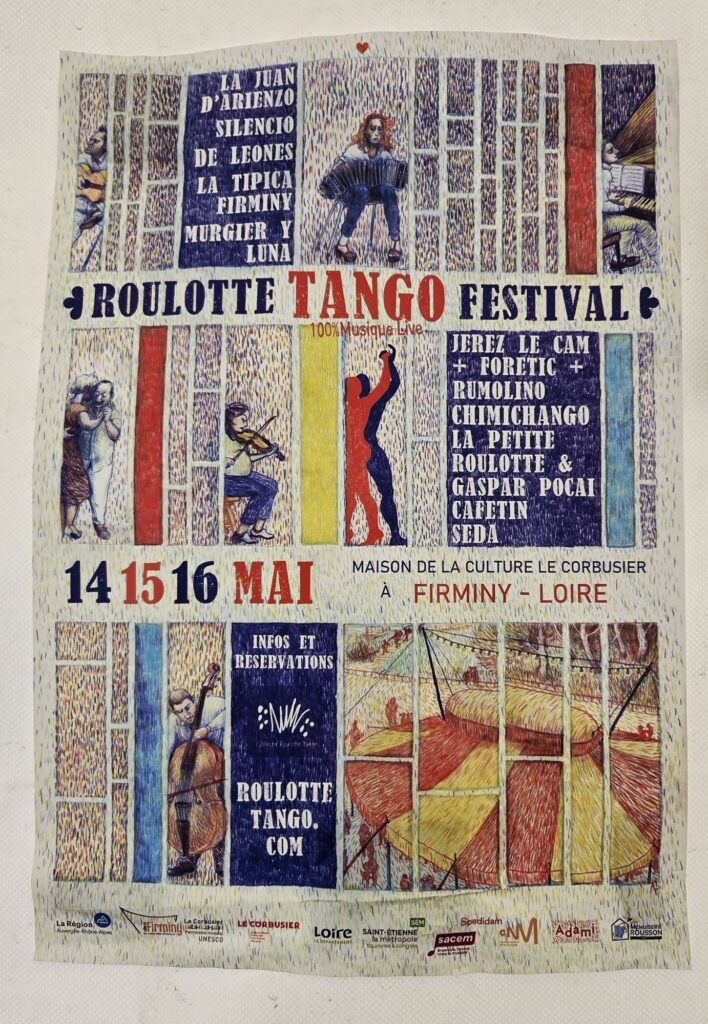
It happened at the 2026 Roulotte Tango Festival, an event where all the music is played by live musicians without a single recording being broadcast over the 3 days of the festival, which is exceptional in the world of tango where DJs are omnipresent.
Before going, I had anticipated a tango festival custom-made for musicians and music lovers. It is true that with 6 concerts a day and more than 50 artists present, a lot went on musically speaking. But it was also a festival open to dancers with a circus tent as the main performance area made of two stages and a large dancefloor which I never saw empty, whatever the style of the orchestra playing. Dance was a vital element to the popular success of the event with couples of all ages meeting and mixing as choice or chance brought them together in the enthusiasm generated by the open acceptance of the range of irresistible music on offer – much of it either new or newly arranged.
In this post, however, I want to share the experience of something which happened in another performance space of the festival. Here are some impressions of the encounter between music and dance at the concert given on Thursday May 14th by the duo Daniel Godfrid & Sebastián Espósito, performing under the stage-name of SEDA. The concert took place in the auditorium of the Maison de la Culture at Green Firminy designed by the architect Charles-Édouard Jeanneret, better known by the stage-name of Le Corbusier.
A remarkable duo
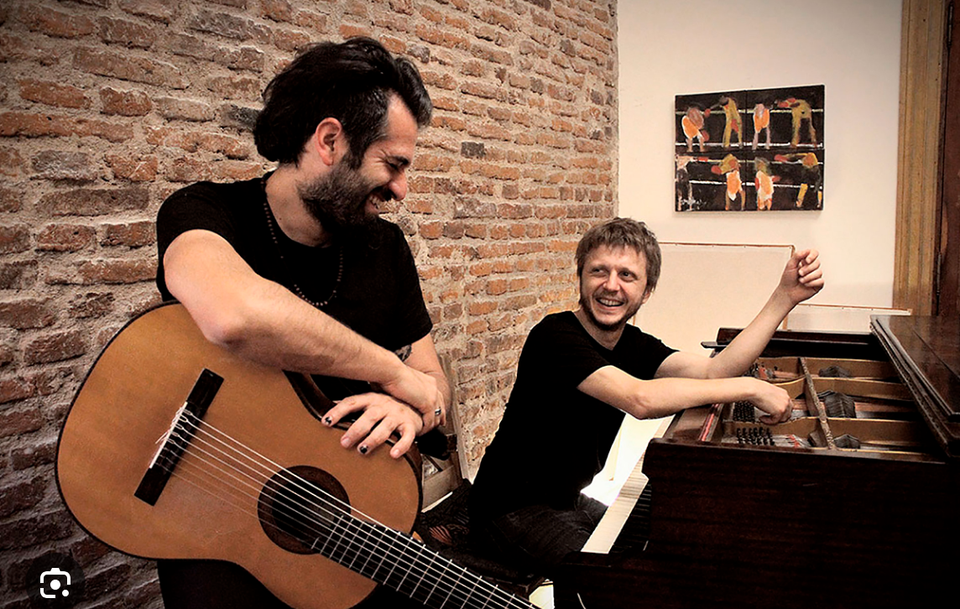
Source – Roulotte Tango Festival
With an outside temperature of 4°C, we were seriously asking ourselves if this was really mid-May or simply mid-winter as we all stood shivering in the chilly wind at the foot of the ramp which led to the entrance of la Maison de la Culture. Fortunately, once we were finally invited to step inside, the warmth from the huddle of bodies queuing by the doors of the auditorium soon made it spring again.
The festival had already got underway in the main circus tent area nearby, but we were curious to see what the first of 3 sit-down concerts would be like.1 I had already seen Daniel Godfrid play live when he was working with harmonicist Franco Luciani some 20 years ago, but I was looking forward to seeing and hearing him again, this time alongside guitarist Sebastián Espósito.
To reach the seating area we had to cross the large open stage space inspired by the theatres of antiquity.2 The musical instruments were already in position in front of the black stage curtain, but it was only when we had reached our tiered seats, which were more Corbusian than comfortable,3 that we got a full idea of how far we were from where the musicians would be playing. Some spectators had even chosen to sit on the floor in front of the tiered seating or against the wall on the right in order to get a closer view. Or so I thought.
Following a warm presentation of the musicians by Julien Blondel, himself the pianist in the Roulotte Tango Collective and one of the festival organisers, the concert began with a classic tango from 1942, Los Mareados by Juan Carlos Cobián, in a version which brushed its way jazzwards without ever losing its tango. SEDA were on song from the start, commanding all our attention with the subtle richness of their sound. The arrangement of Los Mareados which they played is also available on their live album SEDA En Vivo from 2022, itself accessible on YouTube.
Following this opening piece, Sebastián Espósito took the mike to remind us that their music was also intended for dancers. As I would discover reading the programme the next day the event was tagged as made for dancing – but I hadn’t grasped that detail on the evening of the concert.
Sure enough, from the very beginning of the second piece dancers climbed to their feet from where they had been secretly waiting in front of the tiered seating and against the wall on the right – everything suddenly clicked. And they danced. All the way to the end of the concert.
See the musicians or look at the dancers ?
The music sent out a call to those who came to dance which, as the concert progressed, proved irrestistible to the growing numbers who rose to their feet. What soon became quite a crowd of dancers made it difficult not only to look at the musicians as they played, but simply to see them at all as they kept vanishing behind all the moving couples. As for the dancers, it was not only easy to see them but also impossible not to look at them. And even when I tried to shut them out by closing my eyes so I could concentrate on the music, they continued to dance across the screen in my mind.
I usually love to watch a tango dancefloor in motion. It’s like watching the world go by, each couple a fragment of society, each couple with its own unique style and interpretation of the music. But, at the concert in Firminy, seeing those dancers came between me and the music. And I found myself in a home movie in three sequences.
First sequence : I was happy to see people finally dancing to original music which I liked more than the old and often poorly remastered tangos regularly played by DJs at milongas. But I was equally troubled by the presence of all these invaders who seemed to have landed in the middle of … my concert.
Second sequence : Eyes closed, inwardly raging, I told myself that I hadn’t come to this concert only to hear the musicians play but also to see them play – their gestures, facial expressions, body movements and the agility of their hands at work – and somehow try to observe and share this creative moment. Then I opened my eyes.
Third sequence : At the end – even though I observed with a certain sadness that each couple dancing their idea of the music had prevented me from forming my own – I applauded along with everybody else.
It isn’t easy to express or even to admit to feelings like these. After all, music and dance were made for each other. At least that is what I thought – before letting this wave of frustration engulf me. And it was then, amid the inner confusion, that I caught a glimpse of the guitarist’s face between two couples.
Discovering another performance, less visible
While playing, Sebastián Espósito had his eyes on the dancers. He seemed to be dancing with them, accompanying their movements along with his partner on the piano, giving them the music which set them in motion. Then, in a suspended moment, you could see him sustain a note, watch the dancers freeze, then release them as the piece continued.
On the piano, seamlessly, Daniel Godfrid began to do the same, with only occasional glances between himself and Sebastián Espósito. The musicians were at one with the dancers. It was like discovering another performance, less visible, and I felt my inner storm began to quell. There were still as many dancers who constantly came between myself and the musicians, but the music gave birth to something very moving : everyone, dancers and musicians alike, seemed to move in unison in the same direction, each along different paths. I even took out my phone to film and somehow capture and keep something of the vision of all these travellers.
SEDA, Roulotte Tango Festival 2026 – to spot the musicians, just look between the dancers!
Needless to say, by this time, I had completely lost track of the details of the pieces played by SEDA. This unfocused listening was not what I ususally brought to concerts but, oddly, deciding to film helped me refocus. Many titles had stayed in memory, the most well-known standards being El Ultimo Cafe, Por Una Cabeza, Flores Negras, et La Cumparsita. There were also compositions by the duo slipped neatly into the setlist.
The arrangements sounded new but were always danceable, keeping the dancers ever on their toes, careful and crafted in their moves. This dialogue became a source of endless fascination which I hope is at least partly perceptible in the passage from Astor Piazzolla‘s Adios Nonino shared here.
Inviting dancers to listen differently
Ultimately, this concert made for dancing helped me out of my intial misunderstanding and frustration and forced me to see and accept what was happening. Of course there was the moment early on when a complaining inner voice tried to impose itself saying : OK everybody, you can dance as long as you don’t dance in front of the musicians, otherwise you’ll spoil the concert for me ! A ridiculous thing to say. The idea that a concert could belong to me, one audience member among so many, seems stupid now.
I was disconcerted until I realised that it wasn’t my concert. First and foremost, it belonged to the musicians of SEDA and it was their invitation to anyone who wanted to come out and dance which transformed the event. Once that space was declared open, everyone present responded individually : some by dancing, others by accepting to let the music reach them through the filter of an improvised performance of music and dance created live, and the musicians themselves by playing not only for an audience but with that audience. In the circumstances, the dancers had no choice but to listen carefully and dance well because they were also part of the show.
This concert made for dancing demonstrates that tango is capable of creative change when musicians and dancers move closer to each other, instead of standing apart, and collaborate to make change possible. The three days of the Roulotte Tango Festival stand as proof that there are always paths connecting music and dance if only we choose to take them. The promotion of quality live music across all the festival events encouraged emulation among musicians which added value to the great tango repertoire which they invented or reinvented on stage. This gave a sense of renewal to the tango they played, never turning their back on the dancers, but inviting them to listen differently and with the particular sensitivity which is the beating heart of all dancing.
Acknowledgements
Thanks to Daniel Godfrid & Sebastián Espósito for such an unforgettable moment of music which was inspired and all-embracing.
If we needed further proof concerning the duo’s creative range, June 3rd 2026 saw them receive the Sur Prize from the Academia de Cine de la Argentina for the Best Original Score for La mujer de la fila, directed by Benjamín Ávila4.
Their words relayed by social networks following the award ceremony show that this is just the beginning for Daniel Godfrid & Sebastián Espósito : Through the work of SEDA, we have begun to explore new paths : playing, imagining, creating, experimenting, making then remaking, recording then deleting, writing then crossing out and starting again. We have worked constantly and tirelessly. The possibilties are endless and we hope it will continue.
Thanks to the organisers Julien Blondel, Gaspar Pocai, Mehdi Al-Tinaoui and to all the musicians and volunteers who breathed life into the 2026 Roulotte Tango Festival. Long may you run.
Finally, thanks to all the mad dancers who came to the SEDA concert on that chilly night in May for having confused me and then taught me so much. I stayed in my seat at that concert but my mind was dancing all the time. And since then, I have even started to dance again myself.
- The cycle of 3 early evening concerts opened with the piano-guitar duo Seda on May 14th, followed by another piano-guitar duo with Pablo Murgier & Agustin Luna on the 15th, and completed by Gerardo Jerez Le Cam, Damian Foretic & Sandra Rumolino the piano-bandoneon-voice trio on the 16th. The first concert was the only one where dancing occurred. ↩︎
- See p.8 of the Information Sheets made available by the official Le Corbusier webpage for Green Firminy. ↩︎
- If truth be told, the 210 seats were designed by Pierre Guariche, but I was too taken with the expression more Corbusian than comfortable not to use it. ↩︎
- Benjamin Ávila also directed the deservedly critically acclaimed Clandestine Childhood, originally released in 2011. ↩︎
Discover more from GERRY THE KENNY
Subscribe to get the latest posts sent to your email.




One Comment
Pingback: