
Can this really be tango?
This post continues a short series on the musical mix behind the electro tango album La Revancha del Tango released by Gotan Project in October 2001. The previous post, Meet & greet with Gotan Project, presented the various members of the group all mentioned by name in the lyrics of Chunga’s Revenge, which is the third track on the album. We saw that tango instrumentalists were incorporated as part of an electro sound where rhythm was prominent along with vocal elements which definitely weren’t from tango.
Perhaps this explained why in 2001 tango dancers didn’t immediately know what to make of Gotan Project. It was electro tango. But was it tango? Working regularly as a traditional tango DJ at the time, I can say that for the growing numbers of people returning to the dancefloor in the various milongas in France, it was definitely not tango. Okay, so you could hear some bandoneon in there, but to most dancers it didn’t sound anything like what they called tango – golden age classics like the ones in this great YouTube playlist.
The dancers were right about it being unorthodox, but they couldn’t completely resist the new music. For a long time, tracks by Gotan were played as a cortina to be played between classic tangos. One Spanish couple who left the dancefloor when I played some Gotan Project said : “We can’t dance to that. It”s not tango. It’s French music !”
True enough, Gotan Project was Parisian1 in origin, but Chunga’s Revenge has always intrigued me because it name-checked certain tango artists, mixing them in with international names from other musical fields – rock, dub, trip hop and rhumba among them. Perhaps there were too many references, and the details got lost in the mix. In this series of posts, I would like to make sure the names of each artist are now heard, because they all contribute something to the Gotan Project sound.
Chunga’s Revenge Verse 2
Here’s the full version of Chunga’s Revenge by Gotan Project with lyrics following.
Verse 1
Philippe, Christoph, Eduardo / Nini, Cristina, Gustavo /Edi, Line, Fabrizio / Es la revancha del tango
Verse 2
Piazzolla, Troilo, Cugat / Mad Professor y Zappa / Krüger, Dorfmeister, Pugliese / Es la revancha del tango
BRIDGE
Thievery Corporation, Castillo, Castillo
Verse 3
Ana, Miguel, Maria / Noela, Mark, Ruben / Prisca, Arnold y Carlos / Es la revancha del tango
Today’s post begins our exploration of Verse 2. Our focus is the unlikely trio of Piazzolla, Troilo and Cugat. Who were they? How do they fit together? Click here for a closer listen to that second verse.
Astor Piazzolla and Anibal Troilo
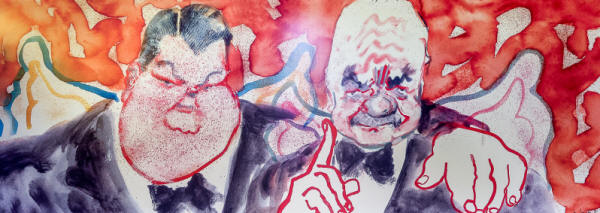
Source Une Histoire du Tango
Troilo is Anibal Troilo (1914-75), legendary Argentinian orchestra leader and bandoneon player, subtle arranger and prolific tango composer. He was also the man who gave the first big professional break to a 17 year-old who used to come every night to listen to orchestra play at the Cabaret Marabú in Buenos Aires. That young man was Astor Piazzolla (1921-92). His dream came true in 1939 when a replacement musician was needed. The teenagerexplained that he already knew all the orchestra’s repertoire by ear – and then proved it by playing whatever he was asked straight off!
Troilo is a huge character in all senses of the word. In 2004, Philippe Cohen Solal wrote : “Think of Anibal Troilo as the Quincy Jones of tango.”2 The comparison works. And Piazzolla had worked out for himself just how good the man was. He turned up, night after night, to listen to the arrangements, the compositions and the style which Troilo was developing at a time when there were multiple tango orchestras elsewhere in Buenos Aires, often playing as many as three sets a night, in an extraordinary time we refer to as the golden age of tango which went from 1935 to 1952. He could have gone to hear many other orchestras, but Piazzolla came to hear Troilo.3
Today, of course, Piazzolla‘s name is known all over the world, whereas Troilo is a name for specialists. The centenary celebrations for his birth boosted his image considerably, as we can see from this video of Troilo’s portrait being painted by Jorge Alio as DJ Marcelo Rojas plays Troilo‘s music for a packed dancefloor at the 2014 Tangopostale Festival in Toulouse, France. It’s never too late for good music.
That said, in 1981, it would never have occurred to Grace Jones or her lyricist Barry Reynolds to rework a track by a prolific composer like Anibal Troilo the way they did for Piazzolla‘s Libertango with I’ve seen that face before. An already famous tune became a hit all over again for a new generation. Yet, in spite of Piazzolla‘s international reputation, Troilo is still considered the most sensitive and expressive bandoneon player of all time by many in the tango community of Buenos Aires and beyond.
And Astor owes Anibal a great deal. In particular, being able to hear his own first arrangements and compositions played by a full professional tango orchestra – even if Troilo was not above correcting and simplifying pieces submitted by Piazzolla because the orchestra needed to play danceable pieces if they were to continue making a decent living. Ultimately, the day came when Piazzolla left Troilo, slamming the door behind him, first to lead singer Francisco Fiorentino‘s orchestra, and finally to create an orchestra in his own name. From 1946 to 1954, the Orquesta Tipica Astor Piazzolla gave life to the revolutionary style which he would make his trademark throughout a career based on refusing to let tango dancers tell him how or what to play.
Piazzolla and Troilo get mentions in Chunga’s Revenge, but they are also to be found on other tracks by Gotan Project. A langourous version of Vuelvo al sur, a song co-written in 1988 par Astor Piazzolla with film director Fernando Solanas for the soundtrack of El Sur, is the closing track for the Gotan Project debut album. In 2004, the group also released remixed versions of Piazzolla‘s Cite Tango, along with Anibal Troilo‘s Tres y dos on Inspiración Espiración, the Gotan Project DJ Set by Philippe Cohen Solal.
Xavier Cugat
Piazzolla, Troilo … and …. Cugat.
Piazzolla and Troilo share the same musical roots. But you have to work a little harder to find the connection between tango and the musician Francisco de Asis Javier Cugat Migall de Bru y Deulofeu, better known by his stagename Xavier Cugat. So who was he exactly?
Xavier Cugat was born in Gerona, Spain on New Year’s Day 1900 – quite an entrance! – and died in nearby Barcelona at the age of 90. Don’t be misled by appearances, because he did a lot of travelling in between. At a very young age, he moved to Cuba with his family where he grew up and learnt to play the violin.
Choosing to make a career in music, Cugat spent years in the United States where his dream of being seen as a virtuoso musician didn’t come true. Nevertheless, driven by ambition, he refused to let himself be beaten and became a virtuoso networker. He went out and met the stars, becoming friends with such figures as actor director Charlie Chaplin and opera singer Enrico Caruso. His friendship with the Italian tenor may well have helped him get hired by Rudolph Valentino to play the role of a musician in the group which accompanied his legendary screen tango in the silent movie The Four Horsemen of the Apocalypse in 1921, the year of Caruso‘s death.
Caruso had always encouraged Cugat, and Caruso‘s aura meant people accepted to listen. Without his charismatic protector, things were tough for Cugat. He was a good violinist, who thought himself exceptional. Such praise was denied by critics. Fortunately, Cugat had a natural marketing ability. Cashing in on his film appearance, he flirted with tango for a while, before picking up the next big thing : the wave of popularity for latino-american music at the beginning of the 1930s, which he would catch from the start, and ride long and succesfully.
He became self-styled king of the rhumba and the bolero, and from 1933 New York was the place where the world would find Xavier Cugat and his Waldorf Astoria Orchestra as house-band at the famous hotel’s Starlight Roof cabaret. Originally hired as support for the star Jack Denny’s Orchestra, Cugat‘s music was so popular that dancers refused to leave the floor when his orchestra finished their set. It was a tricky moment which ended Denny‘s reign, and the Cugat Orchestra became to the main Waldorf Orchestra for 16 years until 1949. According to Wikipedia : “He began with a salary of $500 per week which escalated to $7,000 per week plus a percentage of the door.”
That was way beyond any tango salaries.
Unperturbed by his own eviction from the Waldorf in 1949, Cugat was already appearing in numerous films, selling records and able to fill any venue on tour. As the 1950s came, and rock n roll made life difficult for any musician who wasn’t under 25 and playing a guitar, Cugat went on to become a household name thanks to TV, making numerous appearances on the Ed Sullivan Show,4 right up to his retirement in 1970.
An unlikely trio
Why did these three figures get mentions in a song by Gotan Project? Troilo, Piazzolla and Cugat certainly seemed to be an unlikely trio at first sight, but they have more in common than we may think.
They are all slightly larger than life characters, unafraid of what others may think of their single-mindedness. Troilo and Piazzolla are not the only ones to share a tango connection. According to The King of Rhumba webpage, Cugat actually kept tango as part of his repertoire with his dance orchestra, making tango lessons available as part of the evening’s entertainment – even if it was a diluted version of the Argentinian as you can perhaps hear. They were all entertainers – Troilo with his concern to play danceable music, Piazzolla who rarely turned down a chance to appear on TV, and Cugat who always put on a show wherever he went.
Lastly, they are all from the Spanish-speaking world where the mix maestros behind Gotan Project saw something too caliente to be ignored. Not traditional tango but something new that would take the tango mood to unexplored places.
Founding Gotan member Philippe Cohen Solal seems to resume one of the strengths behind La Revancha del Tango : “This is where you discover a sudden proximity among artists who didn’t know how close they were to each other.” 5
Still want more?
As the remaining posts in this series will show, there are more surprises to come in the Gotan Project mix. In the next expisode eclectic rock musician Frank Zappa and dub-master Mad Professor will rub shoulders. Downbeat specialists Kruder & Dorfmeister will meet tango rhythm giant Osvaldo Pugliese. And the cool music of Thievery Corporation will play in the same room as Alberto Castillo, one of tango‘s emblematic voices.
Subscribe to the newsletter to stay informed of these new publications as they appear.
Notes
- Check out Meet & greet with Gotan Project for more details on this. ↩︎
- Like Troilo, Quincy Jones was famous for his own talent as a musician, arranger and composer, but also recognised and encouraged potential in others. His production credits speak for themselves. The Cohen Solal quote comes from the liner notes to Inspiracion Espiracion. ↩︎
- The website Tango Inside Out sums up Troilo’s musical range like this : “The colours of (Troilo’s) music are the most contrasting ones in the tango repertoire. Soft, strong, playful, dramatic, even aggressive sometimes, abstract, reduced, dreamy – he uses everything.” ↩︎
- There is a YouTube playlist of no less than 17 appearances by Cugat’s orchestra on the Ed Sullivan Show. ↩︎
- Quoted from the liner notes to Inspiracion Espiracion, Gotan Project, 2004. ↩︎
Discover more from GERRY THE KENNY
Subscribe to get the latest posts sent to your email.


One Comment
Pingback: