
What lovelier prospect for a tree than to become a guitar?
VERSION FRANCAISE DISPONIBLE ICI
Diego “Dipi” Kvitko first came to my musical attention in 2006 with the release of the first CD he made as part of the guitar-vocal duo with the singer Walter “Chino” Laborde. The record kicked off their series entitled Tango Tango which, as they explained in the liner notes, was designed to present full sung versions of classic tangos they loved but which were rarely played : tangos which had seen their words erased to become known as merely instrumentals 1, plus a few tangos said to be unplayable.2 At that point, I had been following the work of Chino Laborde with La Típica Fernández Fierro and La Típica Sans Souci for several years, so I was curious to learn more about this new collaboration.
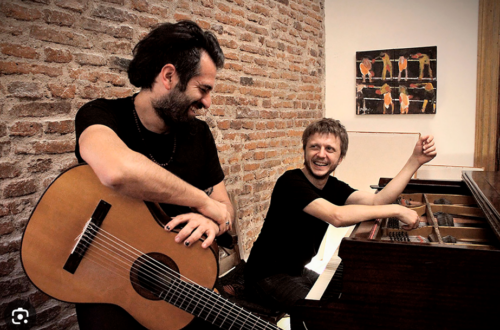
When I finally managed to get hold of a copy of Tango Tango vol.1 at Zivals, the mythical record shop which still sits at the crossroads of Corrientes and Callao in Buenos Aires, and was able to listen to it for myself, it was clear that here were two musicians for whom there was no such thing as an unsingable or an unplayable tango. Kvitko‘s playing in particular was so rich that it sometimes seemed that he had a second guitarist playing alongside.3 Two concerts by the duo seen in Buenos Aires 4 years apart were enough to confirm that Dipi Kvitko was capable of playing like two guitarists at one and the same time. In July 2007, following their sets at Clásica y Moderna, I wrote in my travel log that Chino had found himself a guitarist who was a mischievous monster. Following the second concert in 2011, a memorable evening at the Club Atlético Fernández Fierro, the note in my travel log was more specific : Dipi‘s playing creates a musical environment which is constantly rich and inventive while also giving Chino tremendous freedom to roam vocally.
In March 2026 Dipi Kvitko played in Toulouse three times in the space of two days : one solo house concert on the 25th, and two concerts with Chino Laborde on the 26th. I went to the house concert. Here are some impressions.
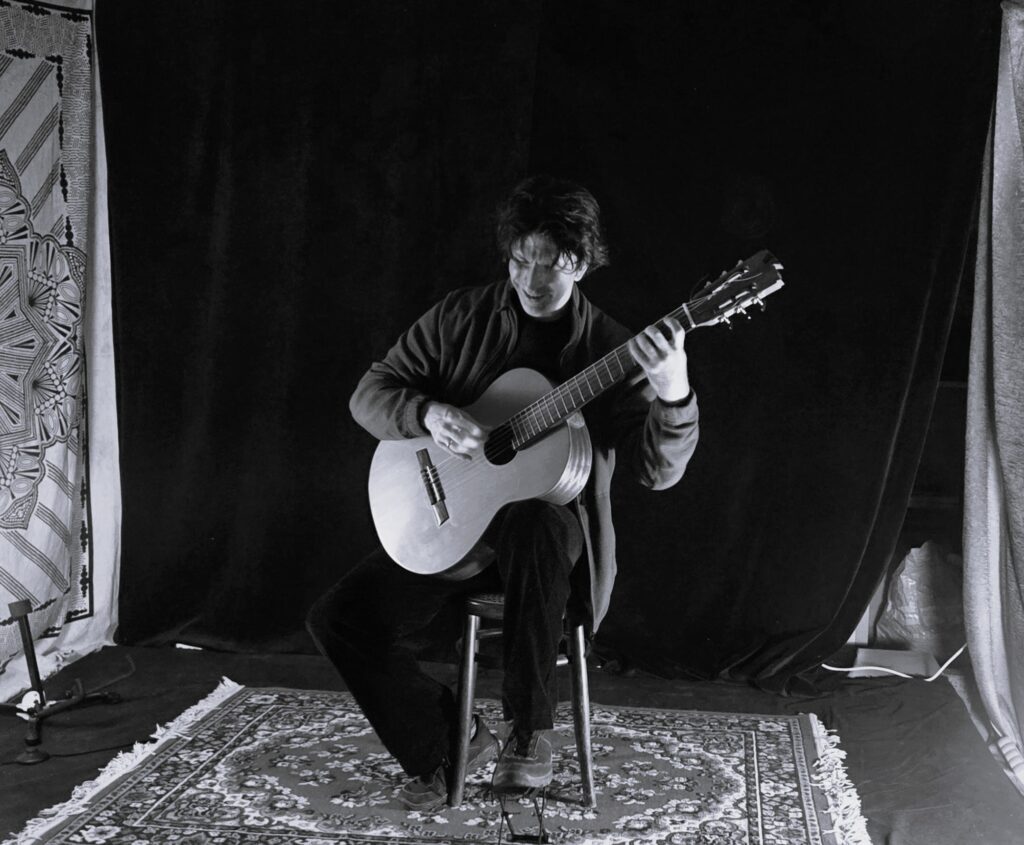
Dipi Kvitko settled in on the small stage before pointing out that, contrary to appearances, this wasn’t a solo concert as he would be playing with a partner … his guitar. With that light but serious remark he began to play with exaggerated slowness, like somebody searching for something misplaced. Gradually, the piece turned into a more familiar melody. What was the name again? I had it there on the tip of my tongue. If only. Then suddenly it came : Oblivion by Astor Piazzolla, now so familiar, and yet Dipi Kvitko was in the process of re-inventing it before our very eyes and ears. And that was just the beginning.
The intimate atmosphere created by Oblivion changed into something more danceable with the following tune, Julian, a classic tango by Edgardo Donato from 1923. The audience wasn’t made up of people familiar with tango, but mostly guitarists who were passionate about their instrument, all invited by Tomás, himself a guitarist and the organiser of the evening’s concert.
There was another change of style with the next piece which was a zamba rhythm from Argentine folk music, Guitarra, dimelo tu, which the musician had already recorded on Tango Tango Vol 3. This evening it wasn’t Chino Laborde doing the singing but Dipi Kvitko whose light, melodious voice gave a ghost-like quality to the words of narrator of the song’s lyrics who considers the meaning of life from out of the depths of a seemingly endless night. Is the narrator alone? Not at all. Like Dipi, he has his guitar for company, and a question which keeps returning : ¿Por qué la noche es tan larga? … (Why is the night so long?) The answer is also the title : Guitarra, dimelo tu … (Guitar, please tell me.)
Along with the subtle stringed magic of his playing, Kvitko also slipped a new line of his own into the words of the zamba – a quote from the poet and singer Ramón Alaya4 – which you will not find in the original version composed by Atahualpa Yupanqui and Pablo del Cerro5, or in the recorded version by the duo with Chino Laborde. Here is the line : No hay un destino mas hermoso para un árbol que ser una guitarra… (What lovelier prospect for a tree than to become a guitar?...) A perfect fit, worthy of a true troubadour.
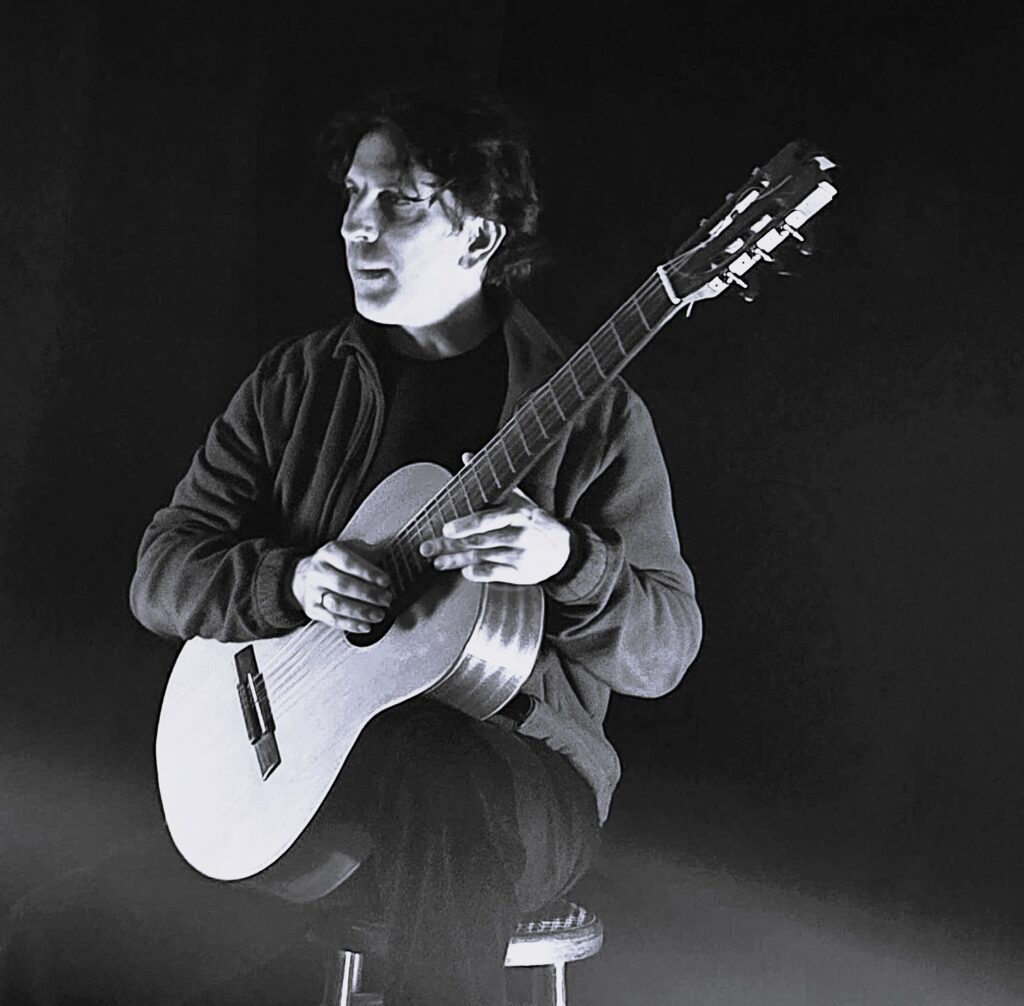
Next, he took us back to some tango standards with Francisco Canaro‘s Sentimiento Gaucho from 1924 and Juan Maglio‘s Union Civica from 1933. They were performed like two movements from the same piece, with a strong emphasis on rhythm while fingers danced along the strings. And, if you closed your eyes, it really did sound like more than one guitar playing.
Once that trip back to the city was over, a different excursion was waiting. The change was total. A folksong took us far from Buenos Aires aboard a raft floating along the waters of the Paraná River6 rocking gently to the contemplations of the riverman in the magnificent Cancion del jangadero by Jaime Dávalos.
But every journey has an end, and the concert was drawing to a close. Inevitably, Dipi Kvitko landed us back in the bustling urban buzz of Buenos Aires, announcing ¡Yira!… ¡Yira!..., a tango by Enrique Santos Discépolo from 1930, as an old song with a contemporary ring to its bitter lyrics on human unkindness : Verás que todo es mentira / Verás que nada es amor / Que al mundo nada le importa… /¡Yira!… ¡Yira!… (You’ll see it’s all just a swindle / You’ll see there ain’t any love /That in the world it’s worth nothing / Round she goes, round she goes!).7
Once the song was over, Kvitko reminded us that Carlos Gardel, the man born here in Toulouse and the inventor of the sung tango, recorded the benchmark version of ¡Yira!… ¡Yira!... as soon as it was published in 1930. Gardel also recorded the following song, Milonga Sentimental, as soon as it became available in 1933 but, rather than sing the milonga, Kvitko chose to put a new shine on Sebastian Piana‘s irresisitibly danceable tune by mischievously speeding it up then slowing it down, gracing it with subtle ornamentations along the way. At each reprise you could see him smile, as if he were already savouring what was coming next before he had even played it.
The concert had covered a great deal of musical territory in such a short time. As members of the audience, that time passed by virtually unnoticed by us. The programme ended with an instrumental version of El Adios, a tango of separation composed by Maruja Pacheco Huergo.8
Dating from 1938, El Adios has today become a genuine tango standard, ever popular with dancers and tango orchestras alike. But Dipi Kvitko played it differently, in a way that prepared us for the inevitable separation which comes as a concert ends by pushing his musical exploration to its limits, ultimately slipping from tango into jazz. The beauty of live music resides in its ephemeral nature, of course, but you can get some idea of how that particular tune sounded by watching the video from 2023 which shows an earlier version of the arrangement he played. In Toulouse, let’s say, he added a few surprises!
Thank you to the tree which became Dipi Kvitko‘s guitar and continues to resonate. And thank you to Tomás for the invitation to share this musical moment.
More Dipi Kvitko?
To help you while away the time until Dipi Kvitko comes to play near you, take a look on YouTube where you’ll find full versions of his two solo albums Qué Grrrande (Vol. 1) and Qué Grrrande (Vol. 2). And if you like to hear tango sung accompanied by guitar then don’t miss the 60-minute concert by the duo Chino Laborde & Dipi Kvitko, intially streamed on April 1st 2021 and still available.
More guitar?
If you’re a guitar fan – and who isn’t when it’s well played? – here’s a post you might like. The rocky road to becoming a guitarist tells the story of how Chester Kamen became a professional rock guitarist playing with people like Madonna, Bryan Ferry or David Gilmour. How does somebody become a professional rock musician who gets to play on the big stage? In this two-part conversation, Chester Kamen shares some secrets from his unusual personal learning journey.
Notes
- I discovered, thanks to Tango Tango Vol 1 that there were lyrics to tangos like Recuerdo, 9 de Julio and Inspiracion, which I had previously only heard as instrumentals. ↩︎
- The original Spanish liner notes use the term : intocables ↩︎
- This reminds me of an anecdote shared by Keith Richards who, as a teenager listening to records by the blues legend Robert Johnson wondered who was the other guitarist playing with him. Later he would learn that all Johnson‘s recordings were done solo. ↩︎
- Thank you to Tomás Horovitz for shining a light on the origin of this mysterious line added by Dipi Kvitko. ↩︎
- Pablo del Cerro alias Antonietta Paule Pepin-Fitzpatrick, was a female French pianist and composer, who was also Atahualpa Yupanqui‘s partner. She composed many of the great Argentine folksongs including Luna Tucumana, Chacarera de la piedras and Guitarra dimelo tu but had to use a male pseudonym to do so. The complete list of her compositions is a long one. ↩︎
- “The Paraná is a river in south-central South America, running through Brazil, Paraguay, and Argentina for some 4,880 kilometres. Among South American rivers, it is second in length only to the Amazon.” Source – Wikipédia. ↩︎
- The translation is by Jake Spatz. You can read his insightful comments and the amazing full English translation here. ↩︎
- Maruja Pacheco Huergo (1916-83) was a singer, actress and composer. El Adios is her most well-known composition. ↩︎
Discover more from GERRY THE KENNY
Subscribe to get the latest posts sent to your email.




One Comment
Pingback: