
Love is a losing game
I still remember how it felt waiting at school dances for the moment when the music slowed down for two or three more romantic tunes where we danced in couples. Boys and girls all stood there wondering if we would finally dare to invite or accept the invitation from the person who’d been keeping our mind off our homework for what seemed like an age.
Whether or not you made it through the fog of desire and found your partner, those slow, steamy numbers blew words at you from a page in the Book of Love, warning you not to go there in the very moment you were throwing yourself into its open arms, trying a little tenderness or maybe just hoping you could stay in step.
Some slows were wordy, some were cute, some told stories and others had no words at all but each one was a lesson in relativity. For one thing, a song you knew well from hearing it over and over on the radio sounded completely new when experienced cheek to cheek with another human being. Depending on who you danced with, those minutes could vary in length, taking you on a three-minute trip into the Twilight Zone.
Welcome back to Songsmiths. Today’s choice, Love is a losing game by Amy Winehouse, is a song barely out of its teens which could have been one of those steamy slows played at those high school dances all those years ago. First released as a track on Winehouse‘s second album, Back to Black, on 27 October 2006, the occasion of its 20th birthday seemed a good time to return and listen again to a song which keeps playing on the inner jukebox we all have in our heads and hearts.
Performed by Amy Winehouse, who wrote it when she was in her early twenties, it tells a tale of experience which some might believe to be beyond her years. The song says it all in just three verses with no bridge or instrumental break. If you blink, you’ll miss it. And, if you don’t find a partner, you’ll miss the dance and have to listen to Amy telling you the inevitability of all that you have lost.
Have a listen for yourself before we dive in.
Love is a losing game
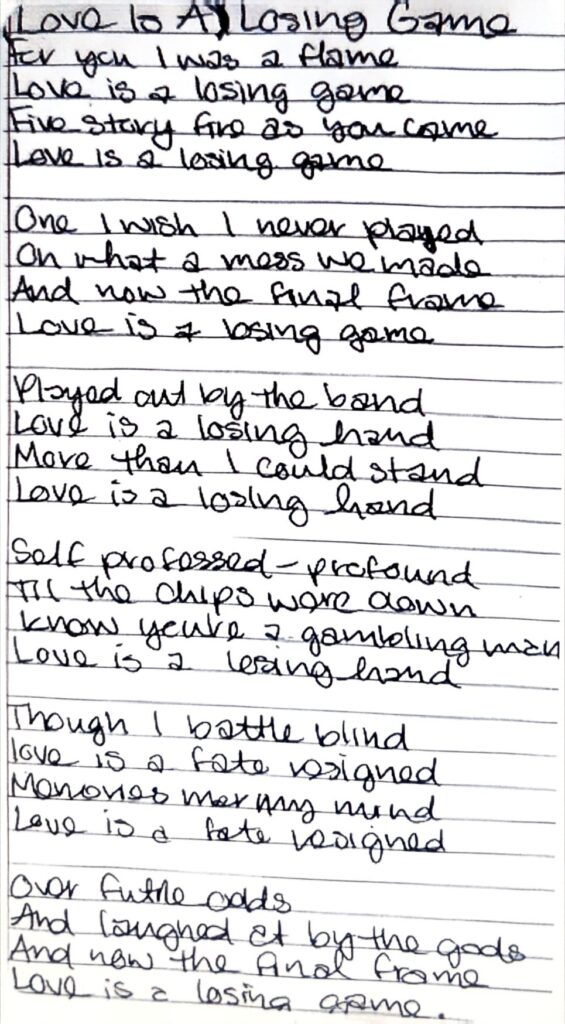
For you, I was a flame / Love is a losing game / Five-storey fire as you came / Love is a losing game / One I wished I never played / Oh, what a mess we made / And now, the final frame / Love is a losing game
Played out by the band / Love is a losing hand / It was more than I could stand / Love is a losing hand / Self-professed, profound/ ‘Til the chips were down / Know you’re a gambling man / Love is a losing hand
Though I battle blind / Love is a fate resigned / And the memories, the memories mar my mind / Love is a fate resigned / Over futile odds / And laughed at by the gods / And now, the final frame / Love is a losing game
Amy Winehouse, Singer Songwriter
The song’s title suggests a confession or a cautionary tale – the sort of song in which singer-songwriters put to music certain events from their own lives or those of people they have known. When Love is a losing game was first released, nobody saw Amy Winehouse as a singer-songwriter. Which just goes to show how misleading appearances can be.
More easily associated for many with performers such as The Shirelles – a girl group whose look and musical esthetic she revered – rather than a brooding singer-songwriter like Carole King who gave the girls their hit Will you still love me tomorrow, Winehouse is much closer to King in terms of artistic depth and subtelty, having composed much of the music she performed, most of which evokes situations from her own experience.1
Love is a losing game has three essential qualities promoted by the singer-songwriter school : it is intimate, romantic and pulls no punches with its warning that being in love can feel like simply rearranging the deckchairs on the Titanic while waiting for the inevitable encounter with the iceberg to happen.
A Masterpiece In Just Three Verses
The song is a masterpiece of precision with lyrics which could earn it a place of honour among the torch-songs in the Great American Songbook. Each verse is woven with the same pattern but using different colour threads, each corresponding to a key-line which appears three times.
In Verse 1, the key-line is the title : Love is losing game. The opening line, For you I was a flame, lights up a picture of a superficial romance where the singer admits she was seen as merely one more lover on a long list of conquests. Both partners are drawn to the passion of love’s flame and the paroxysm of desire which explodes like a five-storey fire. The song is like a movie, but the reference to the final frame makes us want to know more about what happened. The key-line closes the verse – what is a losing game2 we wonder? – but there’s no chorus, and we are already into verse 2.
The key-line here is a variation on the title : Love is a losing hand. How do you play the hand you are dealt in the game of love? The singer doesn’t get a chance to play because she herself is played out by the band, walking off stage with the musicians still playing. Is she waiting to be called back for more? Is she being shown the way out? Or simply leaving a relationship because it was more than she could stand? It seems her partner was sincere – even self-professed, profound – until the chips were down and things got too serious. So maybe she chose not to stay, believing she had no chance of winning with a losing hand against the expertise of a gambling man. Again, the key-line closes the verse – even though life also teaches us that having a losing hand doesn’t mean you’ve lost if you know how to play your cards right, but this is not a song about winning3 – and before we know it we’re into verse 3.
The final verse has a key-line which takes a moment to grasp : Love is a fate resigned. The singer may be a fighter who battles herself blind, she seems to accepts that, where love is concerned, something bad will inevitably happen because fate and the gods are stronger than she can ever be. The odds in favour of her winning are futile. She thought she only had to deal with a toxic boyfriend, but finally realises there was a wider meaning to events that she hadn’t seen. The echo of the laughter of the gods4 is still there for her and for us. It would be reassuring to hear the key-line at the end. After all, Love is a fate resigned and the reluctant acceptance of something inevitable it implies, is some sort of explanation. But Winehouse is in control of the movie in the song and takes us back to the message of the final frame from verse 1 and the cruel reality it portrayed : Love is losing game.
So there it is, a short song written by little lady who knew her notes and set new standards. How would that song have sounded back at those high-school dances as we sweated through those slow songs? To the dancers, probably too short. To those left without a partner or to shy to invite, to accept or even to consider those options, probably way too long. The music is not just in the melody or the singer’s voice but also in the playfulness of the words mocking us from beginning to end.
Do you still want to fall in love? Don’t say you didn’t know and be careful how you play your cards. Love is a losing game is a song that was built to last by an artist who herself came and went too soon. Short, but oh so sweet.
The Final Frame
Amy Winehouse grew up with the jazz tradition which said that a song could always change and grow each time you sang it. To end this episode of Songsmiths, here are three performances of Love is a losing game to wonder over.
NOTES
- The most famous would be Back to black and Rehab. ↩︎
- Losing game is an intriguing expression. Do we play to lose? More here at The Free Dictionary. ↩︎
- Here is an unexpected take on playing with a losing hand. ↩︎
- More on the laughter of the gods here in a discussion on The Philosophy Forum. ↩︎
Discover more from GERRY THE KENNY
Subscribe to get the latest posts sent to your email.

You May Also Like

Songsmith Van Morrison And The Power Of Musical Resonance

Songsmith Steve Marriott exploring tenderness with Humble Pie
