
Love is a losing game
I still remember how it felt waiting at school dances for the moment when the music slowed down for two or three more romantic tunes where we danced in couples. Boys and girls all stood there wondering if we would finally dare to invite or accept the invitation from the person who’d been keeping our mind off our homework for what seemed like an age.
Whether or not you made it through the fog of desire and found your partner, those slow, steamy numbers blew words at you from a page in the Book of Love, warning you not to go there in the very moment you were throwing yourself into its open arms, trying a little tenderness or maybe just hoping you could stay in step.
Some slows were dramatic, some were cute, others had no words at all, but each one was a lesson in relativity. For one thing, a song you knew well from hearing it over and over on the radio sounded completely new when experienced cheek to cheek with another human being. Some told stories and used words that only really struck you once you were dancing.
Love is a losing game by Amy Winehouse was made long after I finished high school, but it keeps coming up on my inner juke box – you know, the one that plays songs or fragments of songs in your head for no apparent reason – as if it had been one of those steamy slows from all those years ago. Sooner or later it was going to be the subject of a post in the Songsmiths series and, as this week marks 20th birthday of the song’s release, Winehouse‘s triumphant second album Back To Black, the opportunity was too good to miss.
Performed by Amy Winehouse, who wrote it when she was in her early twenties, it tells a tale of experience which some might believe to be beyond her years. The song says it all in just three verses with no bridge or instrumental break. If you blink, you’ll miss it. And, if you don’t find a partner, you’ll miss the dance and have to listen to Amy telling you the inevitability of the losing game which is the game of love.
Have a listen for yourself before we dive in.
Amy Winehouse, a Singer-Songwriter?
The song’s title suggests a confession or a cautionary tale – the sort of song in which singer-songwriters put to music certain events from their own lives or those of people they have known. When Love is a losing game was first released, nobody saw Amy Winehouse as a singer-songwriter. Which just goes to show how misleading appearances can be.
For many people, Amy was more easily associated with past pop performers such as The Shirelles – a girl group whose look and musical esthetic she revered – rather than a brooding singer-songwriter like Carole King who gave that girl group their hit Will you still love me tomorrow, Yet Winehouse is much closer to King in terms of lyrical depth and openness, having composed most of the music she recorded, particularly the lyrics which evoke situations from her own experiences.1
Love is a losing game is a fine example of her craft. It has three essential qualities promoted by the singer-songwriter school : it is intimate, romantic but pulls no punches with its warning that being in love can feel like rearranging the deckchairs on the Titanic while waiting for the inevitable encounter with the iceberg to happen.
A Masterpiece In Just Three Verses
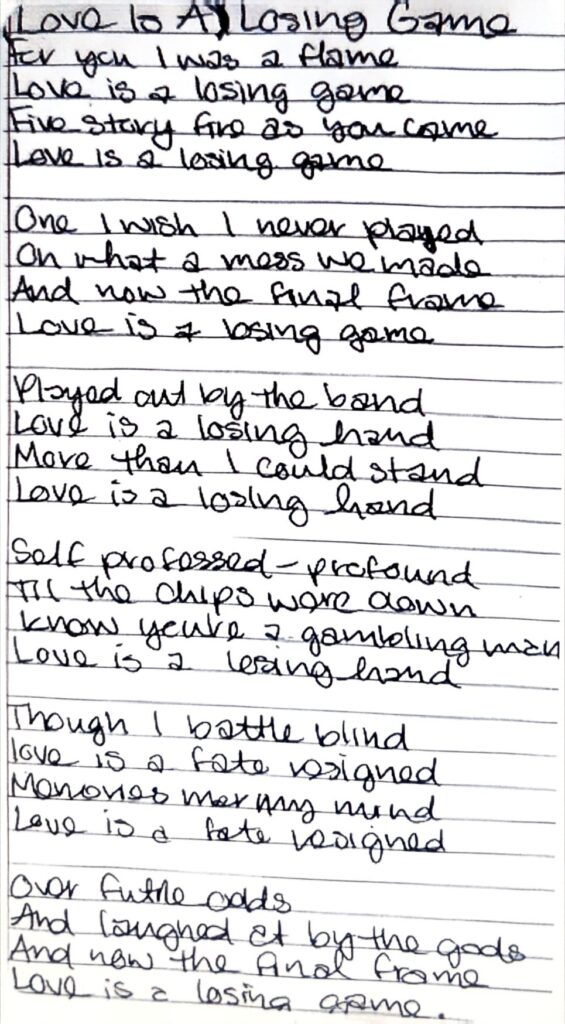
The song is a masterpiece of precision with lyrics which deserve a place of honour among the torch-songs in the Great American Songbook. Each verse is woven with the same pattern but with different colour threads, each one corresponding to a key-line which appears three times.
In Verse 1, the key-line is the title : Love is losing game. The opening line, For you I was a flame, lights up a picture of a superficial romance where the singer admits she was merely one more addition to a long list of lovers. Both partners are drawn to the passion of love’s flame and the paroxysm of desire which explodes like a five-storey fire. The song unfolds like a movie, but the reference to the final frame makes us want to know what went wrong and ended it all. The key-line closes the verse – what is a losing game2 we wonder? – but there’s no chorus, and we are already into verse 2.

The key-line in Verse 2 is a variation on the title : Love is a losing hand. How do you play the hand you are dealt in the game of love when you are bound to lose? The singer doesn’t even get a chance to play properly because she herself is played out by the band, walking off stage with the musicians still playing. Is she waiting to be called back for more? Is she being shown the way out? Or simply leaving a relationship because it was more than she could stand? It seems her partner was sincere – even self-professed, profound – until the chips were down and things got too serious. So maybe she chose not to stay, believing she had no chance of winning with a losing hand against the expertise of a gambling man. Again, the key-line closes the verse. Even though life also teaches us that having a losing hand doesn’t mean you’ve lost if you know how to play your cards right, this is not a song about winning.3 And before we know it we’re into verse 3.
The final verse has a key-line which takes a moment to grasp : Love is a fate resigned. The singer may be a fighter who battles herself blind, she has to accepts that, where love is concerned, fate and the gods are stronger than she can ever be. The odds in favour of her winning are futile. She thought she only had to deal with a toxic boyfriend, but finally realises there was a wider meaning to events that she hadn’t seen. The echo of the laughter of the gods4 is still there for her and for us. It would be reassuring to hear the key-line at the end. After all, Love is a fate resigned and the reluctant acceptance of something inevitable it implies, is some sort of explanation. But Winehouse is in control of the movie in the song and takes us back to the message of the final frame from verse 1 and the cruel reality it portrayed : Love is losing game.
Laughed at by the gods
So there it is, a short song written by little lady who knew her notes and set new standards. How would that song have sounded back at those high-school dances as we sweated through those slow songs? To the dancers, probably too short. To those left without a partner or to shy to invite, to accept or even to consider those options, probably way too long. The music is not just in the melody or the singer’s voice but also in the playfulness of the words mocking us from beginning to end.
Do you still want to fall in love? Don’t say you didn’t know and be careful how you play your cards. Love is a losing game is a song that was built to last by an artist who herself came and went too soon. Having been laughed at long enough, let’s hope she’s laughing with the gods now.
Final Frames
And now the final frame. We know that Amy Winehouse grew up with the jazz tradition which said that a song could always change and grow each time you sang it. Here are three performances of Love is a losing game to wonder over.
More like this?
Amy Winehouse was unique, but the tale of entanglement she tells has been told by many. Two other songs presented in the Songsmiths series offer variations on the same theme.
Chrissie Hynde and the Ladies’ Tea Party which explores the lesson in seduction given by Brass in Pocket, is all about getting another’s attention.
Wreckless Eric Singing About That Special Someone shows just how hard it can be to meet the girl of your dreams who is waiting for you in Tahiti when you are standing in the English rain with the two-chord classic (I’d) Go The Whole Wide World.
NOTES
- The most famous would be Back to black and Rehab. ↩︎
- Losing game is an intriguing expression. Do we play to lose? More here at The Free Dictionary. ↩︎
- Here is an unexpected take on playing with a losing hand. ↩︎
- More on the laughter of the gods here in a discussion on The Philosophy Forum. ↩︎
Discover more from GERRY THE KENNY
Subscribe to get the latest posts sent to your email.


You May Also Like

Songsmith Wreckless Eric Singing About That Special Someone

Songsmith Chrissie Hynde and the Ladies’ Tea Party
