
Where did Mum’s English come from and what was it like?
DISPONIBLE EN FRANÇAIS VIA CE LIEN
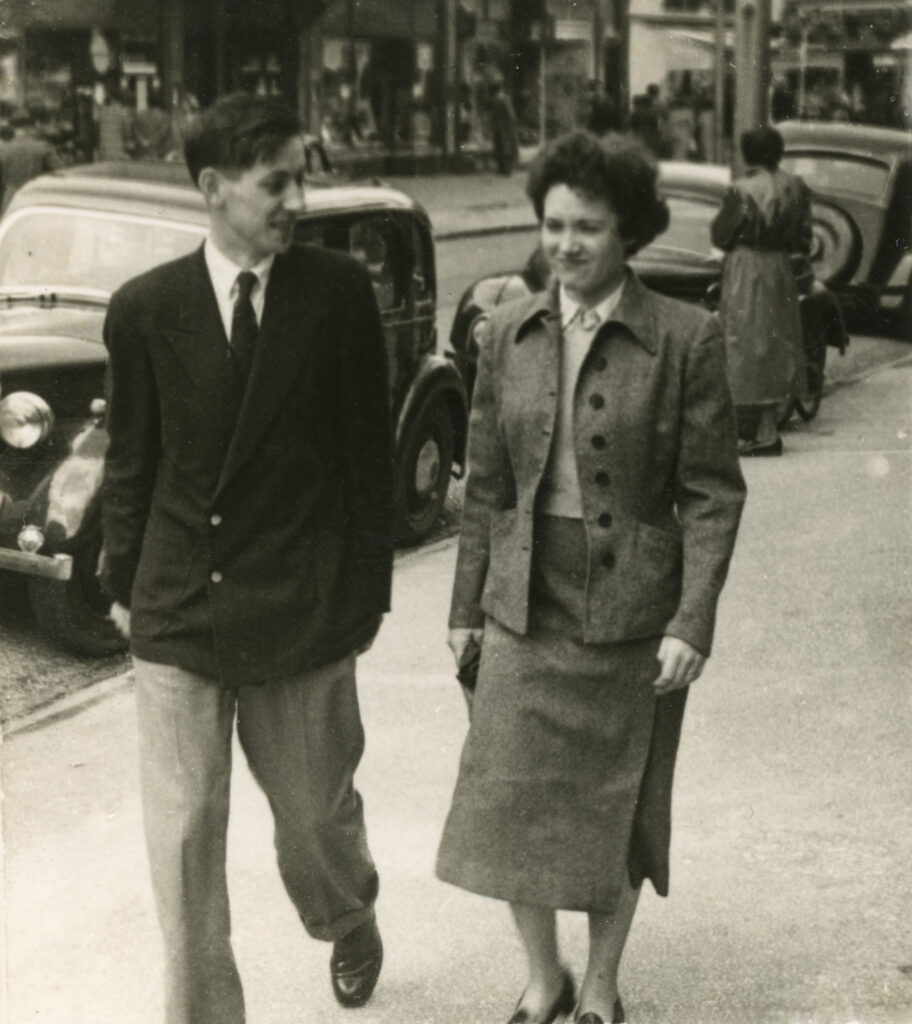
Family
Mum was born Sheila McCarthy in 1932 into a family which was part of a large Irish community on Merseyside in Birkenhead, just over the river from Liverpool. Her parents had both separately crossed the water from Southern Ireland : grandmother Mary Hickey, who we called Nanny, was born in Bilboa, Cappamore, County Limerick and grandfather John Joseph McCarthy, known as Jack, was from Mallow, County Cork.
Jack had been sent away from home at the age of 8 and was apprenticed to learn a trade. He ended up migrating to England where there was plenty of work, starting out a carpenter on the Liverpool shipyards where he was variously employed locally before settling in Birkenhead. He was already 35 when World War One broke out and he found himself in the British army. Wounded in France, he survived the war1 but never talked about what he’d seen, claiming it was untellable. A confirmed middle-aged bachelor, a decade later it would take a word from the parish priest for him to meet and marry Mary, more than 20 years younger than himself.
Nanny Mary was definitely somebody I felt I knew and who knew me. We lived together in Birkenhead for three years before our family moved down to the London area leaving her behind. And yet her personal life remains a mystery to me. I can still picture her, hear her Irish lilt but, strangely, I know more about Grandad Jack – his foreman’s hat, his tobacco, his Cork accent, his passion for horse racing – who died shortly after retiring at 70, months before Angela, our big sister, or any of us were born.2
Jack and Mary had three children, all born British in Birkenhead. School was seen as important but each child got a different version of it. First-born Peggy was deaf and went away to a special school where she notoriously refused to use the sign language which she was taught, and last-born John was a rebel who opted out of any kind of academic effort in spite of undeniable talent and finally went away to sea.3 Middle-born Sheila, on the other hand, was ambitious and hard working, making English a priority from her first day at school.
The proper way of saying things
In fact, after that very first day she came home and told her mother about a whole other way of saying things. The word car didn’t rhyme with care – which would be the Irish pronunciation – and the teacher had told them the class would now have to learn this proper way of saying things. This tells us that the pre-school English she spoke was strongly tinted by Irish speakers without her realizing it. Nanny‘s reaction? According to Sheila, that her daughter was going to learn to speak well made her proud. This was pre-war Britain where Standard English was promoted as the desirable norm in education and employment, regardless of how people spoke in the larger community.
The importance of good English was reinforced again when Sheila passed the 11-plus and won a place at Holt Hill Convent, a Catholic girls’ grammar school near home. It had strict rules which the nuns enforced through a religiously-based educational approach focusing strongly on what was expected of pupils and how things should be done.4 It was a day-school, but one which set out to establish a sense of hierarchy and norms of social interaction where control of language had pride of place – including perfect handwriting and written English. Spoken interaction was just as rule-bound. More than once, Mum recalled, the girls were told that any Scouse accents would have to disappear if they wanted to get on in life. For this, they had elocution lessons at school where Received Pronunciation or RP was the rule.5
She left Holt Hill with impressive School Certificate grades at 16, but her family needed her to quickly earn her living as the oldest able member since Jack‘s retirement. While working at a pharmacist’s she did vocational training in Maths Physics and Chemistry which allowed her to go on to work at the Liverpool Eye Hospital. She loved the complexity of all the terminology and the precision of the job, but marriage and motherhood would ultimately take her out of paid employment for the next 25 years.
A student of dialects
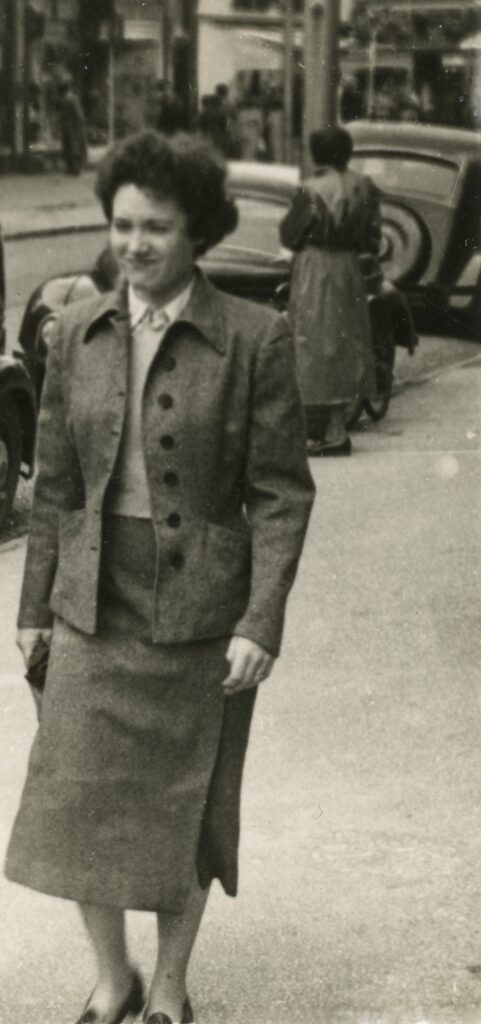
Sheila was a student of dialects who started early so that, by the time she reached adulthood, she’d been through three very different varieties of English. This would continue when our family moved from Merseyside to London when she was in her mid-twenties and Dad left the Merchant Navy to work ashore. The change of region validated the Standard English promoted by school which was closer to the one used down south, but the other varieties would not be lost.
Whenever Mum’s family came to stay, always for a few days because they had travelled a long way, each visitor brought something different. Nanny brought Irishness, even if she was never one to waste words in idle conversation : she said things once and didn’t re-tweet. Sheila’s younger brother John had kept what I saw as a Liverpool accent, sounding like a Beatle, sharing streams of stories from his travels around the world from market-boy in Les Halles in Paris to life as a merchant seaman. Her older sister Peggy, being deaf, was by no means left out. She introduced us to a variety of English uttered via soundless lip-reading where accent was replaced by use of a more expressive face, multiple hand gestures and exaggeration of all sorts. With so many styles of communication on offer, there was always something to puzzle over.
Sheila remained a stickler for linguistic accuracy all her life. For example, she would say that a written word itself will tell you if it is spelt correctly. I remember sick notes she wrote for us to teachers after being off school where catarrh, diarrhoea and gastro-enteritis were always correctly spelt – I know, because I dared to query them and was told to look in the dictionary.
Learning mother tongue
So Mum was a student of dialects who had learnt to switch from one to another. Later on in life, when I had become interested in English as a foreign language, I asked her which she really preferred. “Well,” she said in her artful, now firmly Standard English indecision, “growing up you just knew all three and identified the situations where each was more appropriate because you knew the way you said things influenced the way people saw you.”
I think I also picked up a taste for word definitions from her. Her keenness for us to use the dictionary gave me a lifetime habit which I have also kept in the language classroom. To a student stuck with a reading text I’ve often said : “If you don’t know what a word means in spite of the contextual clues, look it up.” Or again, to someone working on written or oral expression : “If you don’t have a dictionary to hand to find a word you need, use a definition instead.”
Finally, this post also reminds me that Sheila was her mother’s daughter who had grown up with a deaf sister, an elusive brother and an aging father. All of this meant she had developed an ability to sometimes understate or leave unsaid things she thought. When that happened, all you had to go on were facial expressions, eye contact, tone of voice, body language and so on. Picking up on these elements of non-verbal communication when learning and teaching a foreign language is essential.6 Being able to focus on this, while helping both students and trainee teachers understand how to exploit it, has been central to teaching my mother tongue as a foreign language. I now think I probably also first learnt this from the way my mother left things understated or unsaid.7
Still want more?
You can read about the background to my father’s English here. Obviously there are connections, but each parent seems to have travelled their own path. As you will see.
- While Jack lay among the wounded, his family in Ireland were misinformed that he had been killed at Ypres, and they sadly accepted this version of the facts. ↩︎
- I am number 2 of 6. Angie came first, and after me came Simon, Louise, Lawrence and Dan. ↩︎
- More about Uncle John here. ↩︎
- Curiously, British-born artists The Singh Twins also attended the same school decades later and their shared memories of how the place was run can be found here. ↩︎
- Such radical accent-taming procedures may be rarer nowadays but accent awareness in English is still prevalent. I recommend the testimonies concerning accent bias on the Social Mobility Commission website as proof of this. ↩︎
- A useful recent overview of non-verbal communication can be found here. ↩︎
- Another perspective on this can be found in the poem Death’s Door about seeing my mother for the last time and still trying to work out the unsaid. ↩︎
Discover more from GERRY THE KENNY
Subscribe to get the latest posts sent to your email.





4 Comments
Pingback:
Pingback:
Pingback:
Pingback: