
Does more Frenchness mean less Englishness?
DISPONIBLE EN FRANÇAIS ICI
This new post in Learner Tales looks at an episode from the learning of a foreign language following a change of country when an individual or migrant must learn informally outside a classroom. Anyone who has been through – or is currently going through – such an experience, knows it requires commitment, as well as an ability to think on your feet and to think outside the box. It can be inspiring but it is often overwhelming.
How do we manage? By accepting that making room for a foreign language will radically change our relationship with our mother tongue. In my case, that meant taking Frenchness on board where Englishness had previously ruled, and it was triggered in an unusual way. But then, as also shown in the various posts in the Learner Tales section of this blog, learning is a strangely personal affair. So here is a chapter of my story with French.
That’s definitely a waltz
By chance, the other day, I came across a handful of texts originally written in French shortly after I came to live in France permanently. I’ve chosen one of them, C’est bien une valse – which I’m translating into English as Definitely a waltz – to share here. It was inspired by a photo seen in an exhibition of Robert Doisneau‘s work at the Château d’Eau Photo Gallery in Toulouse in the early 1980s. Late November 2025 saw the re-opening of this gallery following 18 months of refurbishing work, so I think this is a good time to write about this long-forgotten text which comes from a turning point in my learning of French, which is now my second language – and on occasions feels like my first. And Learner Tales seems to be just about the best place to do this.
Here’s the text and the photo which inspired it.
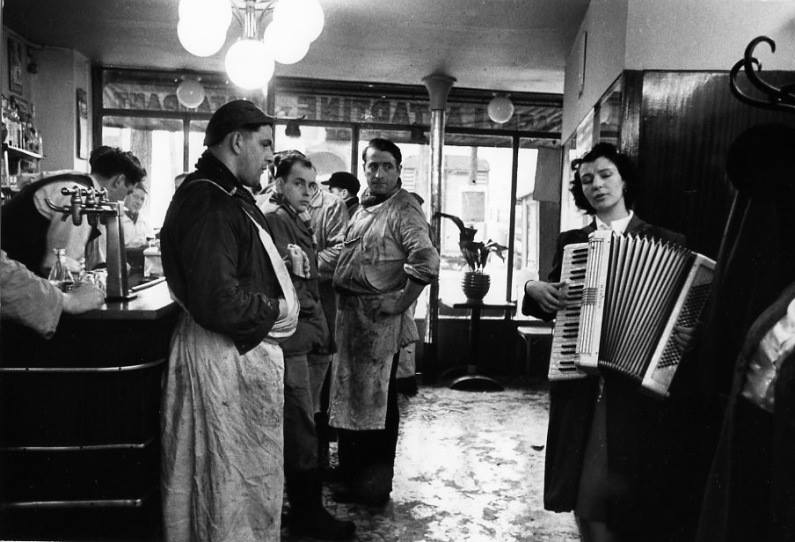
Definitely a waltz
I’d never seen her before, but for the last three days she’s been standing there at the entrance with her suitcase. A foreigner? Not from round here anyway. What can she want? What can someone be wanting at four in the morning when we start work? I’m a butcher and I always get up early when it’s still dark and the world is ours. But she’s not from our world. It worries me seeing her here at a time when everyone is supposed to be asleep. Maybe she’s just a dream? Not three days running.
The others have seen her, I’m sure of that. Why don’t they say anything? I don’t think it feels right to any of us, and that’s why nobody’s talking about her. We see her there, we don’t know anything about her, and we don’t say anything about her. What makes it worse is that she doesn’t seem to even look at us really. I’ve seen people do that in railway stations, people hawking flowers, things for the house. Their voices call out to get everyone’s attention but, when you look at them, they always seem to be looking away, watching, so they don’t get caught. Maybe she’s the one dreaming and I’m just in the dream? Still, nobody says anything, so I decide to forget it.
On the second day, I made sure I got a closer look at her, just to see. I stopped in front of her, a few feet away, but right in front, pretending to tie my shoelace. Which I don’t have, because I wear clogs. That was all I did. Just to see her, and to watch the others go past. But they all just looked straight ahead. And I was watching closely. Not one of them so much as turned his head. Neither did she. Just standing there. Silent as ever, with her suitcase. Got nothing to say myself, come to that. So I let it go.
This morning was the third day, and my mind was made up. Even if she was there, I wouldn’t pay any attention. Just look straight ahead like the others, and all the better for it. We’re here to work, so let’s get on with it. From four to seven this morning we beat all the records. Never seen anything like it. The boss couldn’t believe it. At seven, it was time to go and get something to eat at our regular spot in the market. Boss’s treat.
So we’re all standing at the counter. We all order. I’m waiting, thinking of nothing really. Then, in the mirror, I see the boss’s head turn round. And that’s when it starts, like a sweet song in a foreign language. A waltz. Everyone turns round to look. And it keeps playing. I turn round. There she is. The accordion is out of the suitcase. The others are looking, at last. Even if she still isn’t looking back, that’s definitely a waltz she’s playing. There’s even a photographer. Nods to me and takes his picture. That’s okay. His name’s Robert. We know each other.
The Château d’Eau Gallery, a source and an inspiration
That’s the text translated from the original French1. Now it’s time to say a few words about the resonance of its connection to the arrival of a foreign language because, when I first put Definitely a waltz down on paper, my written French was mainly what was left over from school years, even though living in France had got me into the habit of reading things in French such as newspapers and magazines. My spoken language was slightly better due to regular exposure, but I was far from fluent.
As I mentioned, this text was inspired by a photo, but I had grown up in England without ever going to a photo exhibition. For me an exhibition was inevitably of paintings. That only changed in my early 20s when I moved to France, the home of art photography, thanks to Sylvie, the lovely girl from Toulouse I’d met and am still with today. At the time, we lived near the Château d’Eau Photo Gallery, situated Place Laganne, on the banks of the Garonne in Toulouse, which was often a destination during our numerous walks together – initially the two of us, then the three of us, following the birth of Sam, our oldest.

The gallery was founded by Jean Dieuzaide, a renowned photographer from Toulouse, in 1974. Entrance was free and there was a different exhibition every month. And when you particularly liked a photographer’s work, you could go back as often as you wanted, and even buy a catalogue or a poster, both reasonably priced. If asked to give examples of photographers whose work I discovered at the Chateau d’Eau Gallery, I’d say Gisèle Freund, André Kertész, Edouard Boubat, Willy Ronis, et Robert Doisneau – all names totally unknown to me before that.
These exhibitions revealed not only their work, but also the world they photographed. They all had their own way of looking and a genuine eye for detail. Each photographer seemed to have their own personal situational dictionary and that aspect of what I saw intrigued me. I particularly liked the photos of people caught in real or staged situations.
Not having had any photographic background in my life prior to this – the life in my mother tongue – I identified going to signature photo exhibitions with France and, by extension, with the French language. I perceived all these pictures through the filter of French and, when talking about the experience, I did so directly in the same language, without referring to English at all. New life, new language, new cultural activity.
Language attrition
It’s true that, never having had to do it, I suspect I would have been incapable of talking about these photo exhibitions in English. And if I had tried, I would certainly have said something very different from my French experience. This phenomenon is common among migrants once they become accustomed to the host country. The language of the host country ceases to be a foreign language and becomes the second language, challenging the dominant position of the mother tongue now simply the first language.

This instrusion can be destabilising. There used to be two distinct dictionairies, one for what used to be the mother tongue and another for what used to be the foreign language. Gradually, through daily contact with what is now the second language, things become both shaken and stirred so the familiar music of what is now simply a first language is altered. Instead of two dictionaries, there is only what we can call one all-purpose situational dictionary blending both languages together. There is no longer a word and its translation conveniently opposite each other, as you would expect in a formal learning situation, but simply a nebula of language with features originating from two sources flowing together with which it is now necessary to live.
In this new set-up, and with the passage of time and the accumulation of new experiences, words from the first language can disappear to be replaced by equivalents in the second language. This phenomenon is called language attrition : “Interference from a second language is likely experienced to some extent by all bilinguals, but is most evident among speakers for whom a language other than their first has started to play an important, if not dominant, role in everyday life; these speakers are more likely to experience language attrition. It is common among immigrants that travel to countries where languages foreign to them are used.” 2 Typically, migrants stop using their mother tongue systematically and, gradually, for lack of interlocutors and situations requiring its use, attrition occurs creating linguistic gaps which are progressively filled by tools from the language of the host country.
One language can mask another
Of course there are ways to resist against the infiltration of the second language. They generally require turning away from the influence of the host country and turning towards first language and first-language culture – an option which is only a click away these days via the magic of our smartphone which is easily connected with first-language sources, whatever that language may be and however far away it is spoken.
In my own case, I didn’t want to retreat into English or the English-speaking communities, clubs and activities were existed here and there. Learning French was a key to my integration. Turning exclusively towards English was not an option. Today, this means that linguistically speaking, a migrant person with a smartphone does not live as entirely in the host country – which opens up a completely different learning path. In the early 1980s, French had become my daily language and the only thing remotely resembling a smartphone was the Starfleet Communicator in Star Trek.3 Living abroad meant living on another planet. And there was no-one to beam me up.
How did I maintain my English? Mainly through my work teaching English as a foreign language to professionals in French companies. I was part of a team of migrant native English-speakers like myself all doing the same job. I kept my English alive by using it in class and when interacting with my colleagues. Our status as native English-speakers may have given us jobs4, but speaking good French was essential if we wanted to live happily in France. The ability to speak well meant that people took us seriously and respected us.
Certain colleagues had studied foreign languages at university and knew a lot of French. Others like myself built on school French and the ongoing learning made possible by our life-partners who were often French and by daily immersion in the language. All my native English colleagues had to answer the same difficult but essential questions : Can I gain in Frenchness without losing my Englishness? Will the massive input from the second language I’m learning necessarily end up masking my first language and mother tongue? How am I going to cope with all this?
Accepting the music of the foreign language
Unexpectedly, visting the Château d’Eau Gallery enabled me to find answers to my questions concerning how to accept the unrefusable refrain of the French language which was gradually wheedling its way into my life in a big way and changing the linguistic balance.
Going to various photo exhibitions as the months passed, I became aware of a private sensation which occurred more and more frequently : the disappearance of my inner voice in English, and its replacement by an inner voice in French.
The French in question was far from fluent, but it was quite sufficient for everyday life. But with only one listener for the inner voice, that didn’t matter. This change in language of the inner voice felt like the tipping point into a different sort of music. Initially it gave me a spinning feeling. Then, one day as I was visiting a photo exhibition, I picked up the voice of one of the characters in a photo. Then another. And another. Each voice came to me as an inner narrative which sounded in French. I let them come and imperceptibly let any reticences I may have had about such intrusions fly waltzing out the window. This process was risky but gave me my first true feelings of linguistic Frenchness.
With time, I understood that the odd spontaneous orality of what had seemed to come from those photos was actually my own inner voice in what was fast becoming my second language. I crossed the line from oral to written, putting down several texts on paper – my first attempts in French, with varying degrees of success – with no other aim than to momentarily try on the trappings of the language and lives of the characters. Without needing to use the English gate to expression, I had found a way to embrace Frenchness without fear of losing my Englishness.
Today I’m both languages. I know how to tango and to waltz. Sometimes the music of one slips into the other. That is something which used to bother me. I have now learned to take these things as they come.
Still want more?
For a more recent narrative developed from a photo on this blog : Going against the flow : faces in a crowd inspired by a picture taken by Alejandro Diez.
Visit the English home page for the Atelier Robert Doisneau. This platform runs accounts on various social networks with followers able to receive almost daily photos from the massive Doisneau archives. Why not sign up?
Language learning is a pivotal part of migrant inclusion as the information on the website for the non-profit organisation Open Cultural Center underlines. This European organisation focuses mainly on Spain and Greece, but their resources are open to people all over the world.
Notes
- The original, which is in pretty basic French, is available here in the French version of this post. All posts in the Learner Tales section of this blog appear systematically in English and French with a link to the other language at the beginning of each post. ↩︎
- Source : Wikipedia page on Language Attrition. ↩︎
- Star Trek really did have a determining role in the development of the mobile phone. ↩︎
- This is a vast subject. Perhaps something to come back to another time. ↩︎
Discover more from GERRY THE KENNY
Subscribe to get the latest posts sent to your email.




2 Comments
Pingback:
Pingback: