
VERSION FRANCAISE DISPONIBLE EN CLIQUANT ICI
Look at foreign and try saying it. Such a strange word. I first became aware of the word foreign when I was 5 or 6 years old. I remember the encounter distinctly.
The lead pencils we learnt to write with at school all had the word foreign written on their dark green wooden barrels near the top in gold letters. We were all learning to read1, and were gradually becoming more and more able to decipher new words on our own. I didn’t notice foreign immediately, certainly being more interested in the writing end of the pencil but, once it caught my attention, I had to know more.
Was foreign just on my pencil? Looking around me in class, I saw that everyone’s pencil had foreign on it. When the opportunity came I asked the teacher, probably mispronouncing the word in the process, why it said foreign on our pencils. The answer I remember getting was something factual : “That’s because the pencils were made in a foreign country, not in Britain.“
Fair enough. But the word still looked peculiar to me. It was that silent g which would guarantee the word pride of place in umpteen spelling tests which troubled me. I would have to wait a few years before studying the history of English where I learnt that foreign was a foreign word. This migrant word came into English in around 1300 from the medieval French forain designating an outsider to a community, somebody born or from elsewhere.2
It turns out that foreign was spelt forain or forein for a long time, only getting its g-spelling in the 16th century by analogy with sovereign – even though the silent g in that word comes from reign which derives from the Latin regnum where the letter g is sounded.
Writing with a foreign pencil
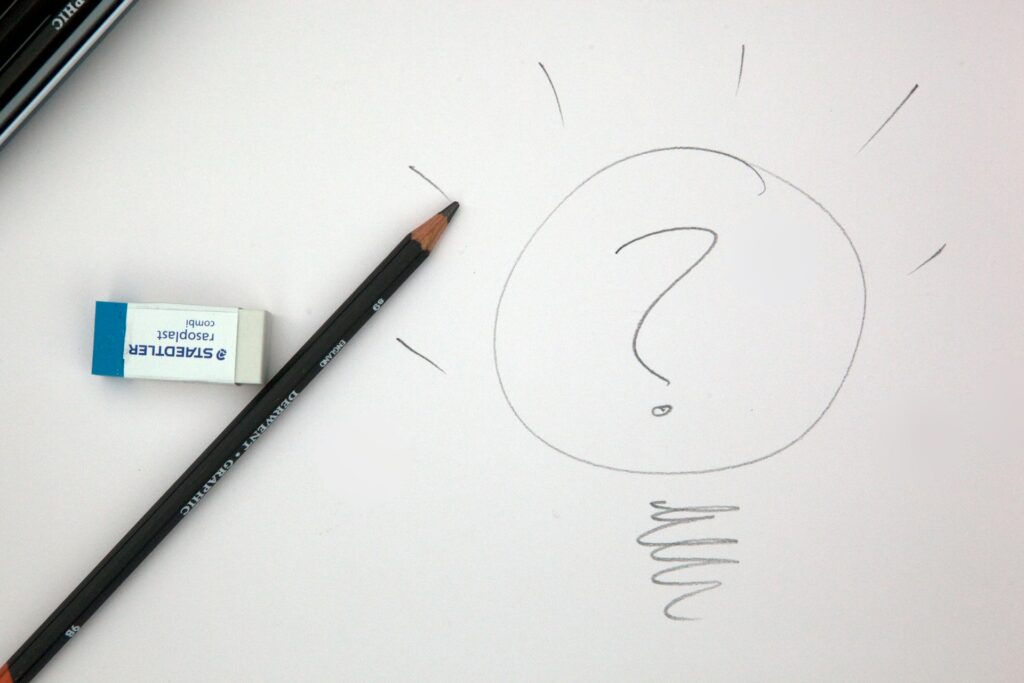
For the 3 years I was at infants’ school we wrote most things in class with our foreign pencils, only slowly moving on to ink pens with their mysterious nibs in Year 3. Our pencils were standard issue with triangular-shaped wood casing which gave a surface for each of the three fingers of our writing hand to grip, thereby reducing fatigue.
Learning to write confidently and untiringly means writing regularly, of course. In formal terms, that means being able to hold a pencil, but also placing words on a line, maintaining regularity in the shape and size of each letter. In terms of content, it requires the writer to find things to say and ways of saying them so that it all shines through in sentences of their making. There is something foreign about the result : born elsewhere in the writer’s mind, an idea suddenly there on the page, accessible to any member of the reading community even when the author is nowhere to be found.
A specific quiet time in class was devoted to periods of free writing when we blackened the pages of our Busy Book : a small exercise book where we could write anything we wanted as long as we filled a page.3 This was a ritual activity where the books were distributed by the teacher, we wrote, then they were collected up again. Out of the blue, I recently acquired my Busy Book from when I was 6 years old among the items retrieved from my parents’ home following my mother’s death. Something I abandoned unknowingly all those years ago which she had kept, giving me a completely unexpected sample of my earliest handwriting.

I don’t know what my classmaates wrote about in their Busy Book. Mine was a blog of sorts about the weather, things I’d done, seen or heard, all built around family and school. You don’t see yourself as a user of the language when you’re 6, of course. You just have to slow down and enjoy the journey.4 But there’s thinking going on in the texts. As you can see from this blog, writing is still a central activity for me today, so it’s moving to have those initial indelible traces of me as a user of the English language, tracing ideas and events thought up elsewhere which then migrated onto the page. They were all in English, and all written with a foreign pencil. Did I write all that? Or was it the pencil? Hmm. Have to think about that one.
Foreigner and foreigner
In what I can foresee as being a series of posts, I would like to look at what foreign means to me through situations and experiences concerning language, learning, teaching and travel.
Today’s tale of innocence is my first piece on the theme of foreigner and foreigner. The second piece, a tale of experience is available here.
Now it’s time to put into French.
- Children in the UK start school after their fourth birthday. I would have turned 5 a few weeks after entering reception class. ↩︎
- See also the Littré French online dictionary which mentions the Spanish foraneo from the Latin foras meaning outside. ↩︎
- A web search reveals that Busy Books are now connected to Montessori. Maybe they always were, but I didn’t go to a Montessori school. Here’s a thread on Quora which says more about the Montessori Busy Books available today. ↩︎
- A post on the overcoming teacher classroom anxiety explores this ides of slowing down to enjoy the journey from another perspective. ↩︎
Discover more from GERRY THE KENNY
Subscribe to get the latest posts sent to your email.



3 Comments
Pingback:
Pingback:
Pingback: