
Trees pay a high price for extreme weather and climate events
CLIQUEZ ICI POUR LIRE LA VERSION FRANÇAISE
In a previous post1 I have already written about the effects of the historic wildfire in the Aude region of France in August 2025. Here is the story of an encounter with an uprooted tree still lying unmoved 2 months after the passage of Storm Nils2 in February 2026. Trees have paid a high price for extreme weather and climate events in the Aude region.
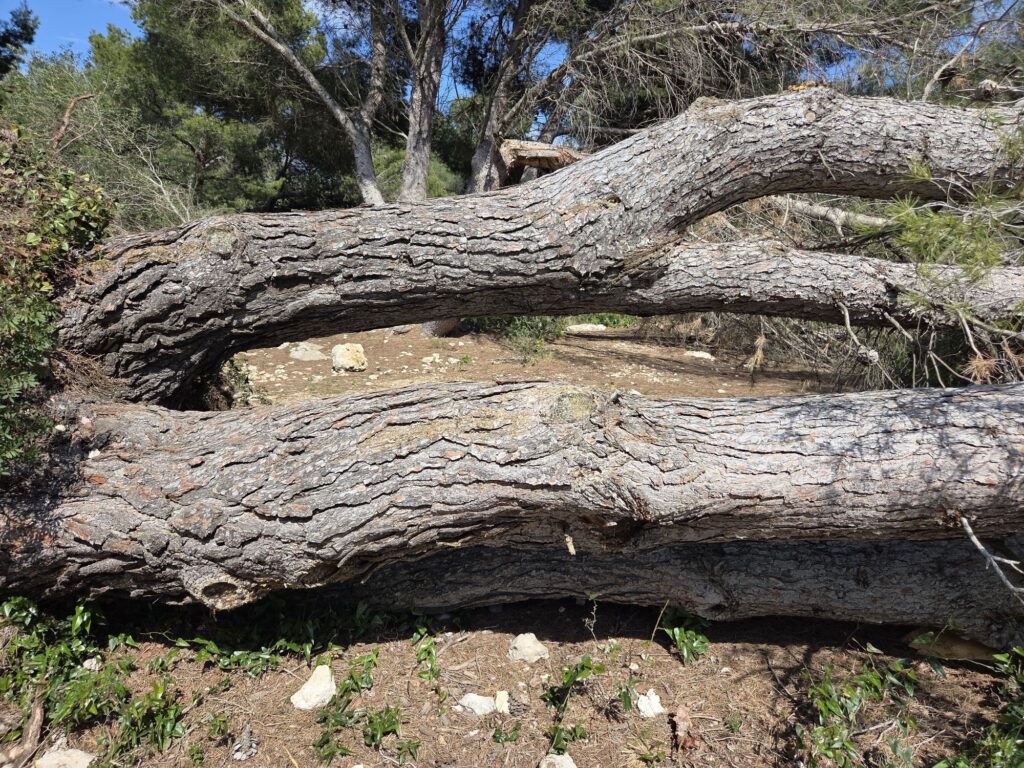
A sleeping tree which none dared awaken
The other day we were spending a fine spring afternoon out walking on the plateau of Leucate3 when we decided to follow a new trail away from the main road leading to the lighthouse which everyone else seemed to be taking.
This unexplored path seemed easy to follow as took us through a small wood of Mediterranean trees and wild herbs surrounded by land which carried the marks of pastoral farming and wine-growing.
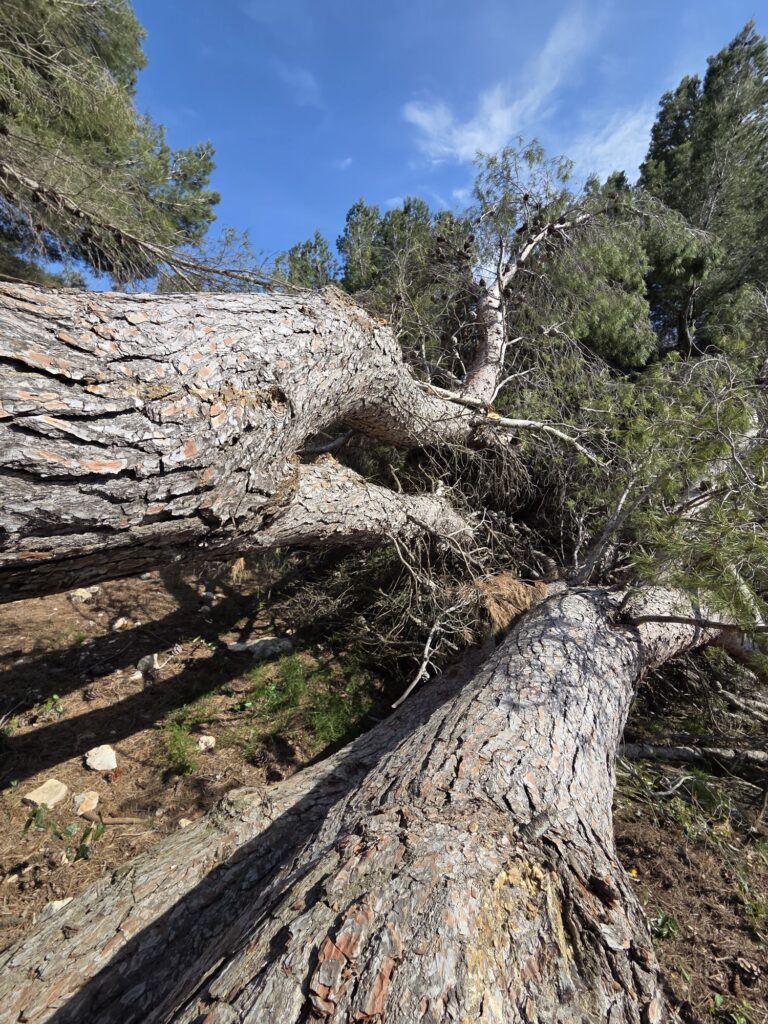
Sure enough, the path was easy to follow until we came to the obstacle of an uprooted tree lying stretched out on its side. What were we to make of this? After all, a tree should be height, breadth and volume. But this tree, robbed of its height, had been left here sprawled on the ground, as if it had fallen into a deep sleep from which none dared awaken it.
Lying there motionless, its primary branches seemed to be reaching skywards imploring for help. Except that the sky had changed places and was now looking down with its bluest eye on what was a wooden corpse, no longer even flailing on this sunny afternoon.
The story of one branch in particular
Out of nescessity, and believing that we would be able to continue along our path, we walked around the tree. It took a while, and this surprised us. The trees around us which had been left standing not far from the one the wind had upended didn’t seem unusually tall, even though they were much taller than we were. And it was then that I remembered a lesson I had learned recently.
The morning after Storm Nils, I had discovered that there could be a major difference between the weight of a tree which had been blown down and the apparent light elegance of a tree still standing. Because that same storm had torn numerous branches from the big tree overlooking our house in Leucate village which gave us such welcome shade on hot days, throwing them down with insolence as debris to be discarded.
I don’t want to consider a whole tree here, but one branch in particular which the wind had wrenched from our big tree.
This branch had somehow landed in such a way as to be hanging either side of the fence between our downstairs neighbours’ and our next-door neighbour’s gardens.
From our first floor home, moving the branch to save the fence seemed to be a mere formality. But once we were down there to actually carry out this operation, it soon became clear that the branch was so heavy that moving it was impossible. I had imagined something straightforward until the moment we seized it with all our strength with the intention of moving it to a safer position. But our small human hands were ridiculous in the face of the task to be carried out. We would have to wait for a visit from the fire brigade equipped with a chainsaw to cut it into handlable chunks, finally easing the strain on the wooden fence which threatened to buckle beneath the weight at any moment.
A mineral presence amid the vegetal violence
Now let’s get back to the moment on the plateau where we had just walked round that uprooted tree and grasped just how big it really was. That size in turn then seemed disproportionately large to the display of roots with which our tour of the tree ended. So few roots for such a tall tree?
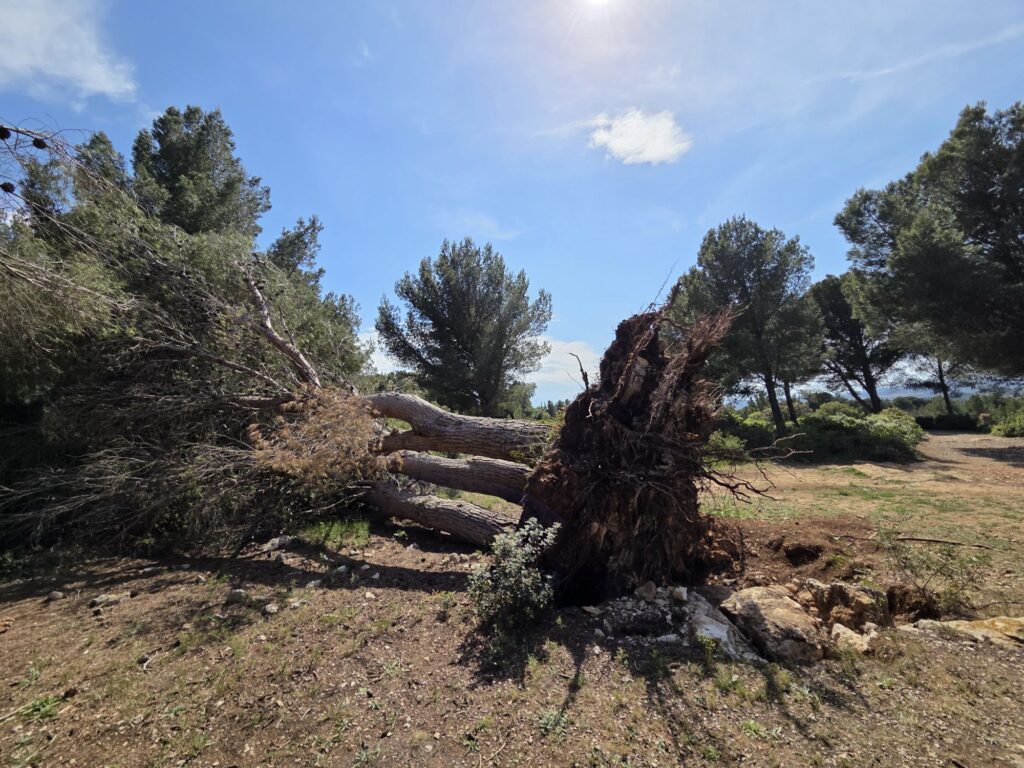
The roots are the invisible part of a tree when standing and, before seeing them revealed by an uprooting, the only vision we have of them is in our imaginations. For a tree as big the one we had just come round, I would have imagined a more developed, more complex root system. Looking at the evidence before my eyes it took me a while to understand how such a big tree could hope to resist against so much wind with such apparently shallow roots.
It was seeing the chunks of rock tangled up in the roots which cleared my mind’s sky. This mineral presence amid the vegetal violence revealed the nature of tree’s connection with this limestone substrata which prevented any possibilty of deeper roots. Positioned where it was, in spite of having grown in a region where strong winds are a daily occurence, the tree had no chance against the storm wind which had turned it over.4
We had started out by exploring a path. We had ended up exploring a tree. In the silence which fell upon us as we stared long and hard at this tree which had fallen, but which was clearly still alive, the only breath to be heard was that of the ordinary wind which is such a permanent feature of the plateau of Leucate.
In vain, the wind tried to reactivate branches which it had been able to make dance so easily and so long until this sudden uprooting.
What’s next on the extreme weather programme?
As I write this text, the G7 Environment Ministers’ Meeting is taking place in France with no mention of the climate crisis or global warming in order not to upset the American administration which denies that such things exist.
Notes
- Eye-awful wildfire in France published on 2 September 2025 ↩︎
- An overview of the damage caused by Storm Nils in SW France in this report. ↩︎
- More here on the exceptional natural area of the plateau of Leucate. ↩︎
- Roots are fascinating things, as the Roots Section in this article on tree anatomy shows. ↩︎
Discover more from GERRY THE KENNY
Subscribe to get the latest posts sent to your email.




3 Comments
Pingback:
Antonella Toffolo
« We had started out by exploring a path. We had ended up exploring a tree. »
Thank you for this story, I found it really touching and since in these days I am very much into the subject-matter of trees, I would like to point you out to another story by a famous Italian neuro-biologist, Stefano Mancuso, who has got an incredible and sensitive eye for plant intelligence and who is a wonderful storyteller as well.
This is the link: https://worldsensorium.com/life-always-wins/
I hope you will enjoy it!
Have a great day,
Antonella
Gerry Kenny
Thank you for these kind words, Antonella. And thank you for pointing me to the beautiful story by Stefano Mancuso which echoes my own in numerous ways, particularly in the unfolding of events, the way that one discovery leads to another. I had heard of his work on plant intelligence but the Japanese encounter shows how a powerful idea is always already connected to things we have already experienced – in Mancuso’s case the mysterious fish dish reminding him of something he couldn’t name, in mine the uprooted tree which took me back to the surprise of the weight of a branch fallen in a storm – and to those we have yet to discover.
Reading “Life always wins” I particularly enjoyed the idea of Italian being spoken in a conversation in Japan : it is so unlikely that it seems perfectly natural. As someone who has lived abroad and taught my mother tongue as a foreign language all my life, I am particularly interested in moments like these, as you can read here.
To finish, here’s a tree quote I heard recently and which appears in an earlier post : What lovelier prospect for a tree than to become a guitar?
Thanks again for reading the blog and sharing a great story.
All the best,
Gerry