
CLIQUEZ ICI POUR LIRE LA VERSION FRANCAISE
Welcome to Learner Tales. The articles in this section are part of a project about giving visibility to the routes people take in order to learn. I intend to explore some of my own learning experiences, and, when the opportunity arises, to go out and talk to different people and get them talking about learning their way.
To kick off the English side to the series, here’s something from me about rugby.
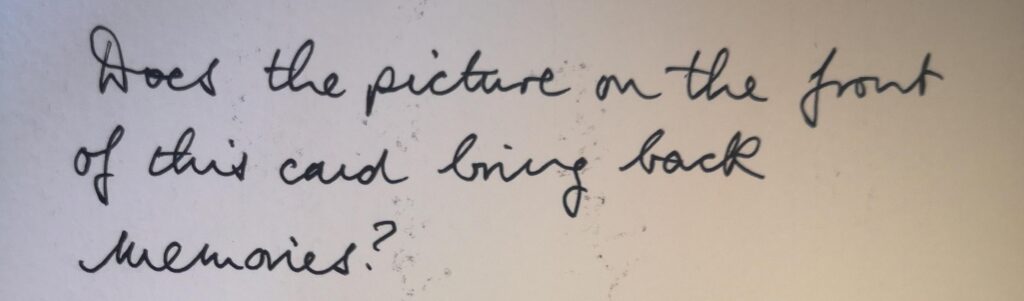
Yesterday I had my first birthday since my mother passed away in January. This morning I found a birthday card she sent me years ago with a picture of a rugby match seen from a player’s point of view. Along with the greeting, she wrote a question.
Sheila Kenny née McCarthy
And as we are currently in the throes of the Rugby World Cup 2023, I think this is probably an appropriate time to share these two texts about learning to play rugby because Bringing Down The Pine and Scrum Crush are my answers to Mum’s question. A few words about the context follow at the end.

Bringing Down The Pine – AUDIO
Mr Davies showed us the basic principle
Of what would become the rugby tackle,
Before our very eyes, without a sound,
By bringing a running giant to the ground.
The key was courage, whatever our size,
He said, for each team’s Goliath had eyes
Set on getting the ball across our line.
The tackle was there to fell swoop the pine.
Did we have any questions? But then who
Could muster even one? As we all knew,
He who so much as even dared to ask
Would be the next to field or to feel the axe.
Scrum Crush – AUDIO
Breathing is a luxury
Which I remember vaguely
From when bodies were against.
Now they have all collapsed
And the unmoving names dropped
Onto me from the matchlist.
Both my head and the other hooker’s
Blink at the props, our overlookers,
All caught stuck here in the same scrum crush.
Teeth grind and ribs groan as we nurture
Dreams of second row furniture
Being moved, restored to the rush.
Awful view from this front row seat.
But I tell myself to be strong,
That it’s here I really belong

Comments
Bringing Down The Pine is set in 1968. I was 11 and had just started at secondary school. John Davies, our sports teacher, who also played scrum half for the mighty London Welsh in the late 1960s, introduced us to the rugby tackle by effortlessly bringing down Tomás Brown, an 11 year-old giant and the biggest boy in the class, who he asked to run at him at full speed. Tom was delighted at the idea of finally being given permission to give everything he had without fear of hurting the other person. We watched awestruck as John Davies, who was much smaller than Tom, took him down effortlessly. but John Davies said he was able to make up for that difference because he knew how to tackle. This was what we were to learn.
This lesson in bringing down somebody much bigger than ourselves with a tackle opened up a whole new world and the prospect of long hours of work. Never one to waste words in vain celebration, Mr davies told us not be let ourselves be over impressed by what we had just seen. Tom was certainly stronger than him, he said, but knowing how to tackle wiped away that advantage. If we wanted to play rugby, we would have to learn to play against people of all sizes and in order to that we needed to learn how to tackle. It was certainly hard work, with its fair share of bumps and bruises, but it was also a source of great collective satisfaction. When one person tackled, the team tackled.
Sadly, Mr Davies left St Mark’s in Harlow the following year when he was appointed at The Campion School in Hornchurch just where he took school rugby to new heights. But back on that grey autumn afternoon in 1968, after bringing Tom down with such ease, he told us not to be impressed.
And we did learn, because he taught us how to do it without being afraid. When faced with a hefty opponent – or running after one, because there was a big lad to chase in every team that nobody wanted to tackle – all you needed to say to yourself was that he was coming down. Fear was still there, but we tamed it with anticipation : arms around the legs, shoulder firm, head to the side, then snap his balance to bring him tumbling down.
I have discovered that a version of this technique can come in useful when dealing with unwieldy individuals who come charging at you in life in all sorts of situations miles from a rugby field. You can’t let some people get past you and, even when it hurts, you have to remember what you know in order to stop them. With other people, you can let them think they can get past you because you’ll tackle next time when they least expect it.
Scrum Crush is an impression of how it felt to be a hooker when the scrum collapsed. I was older, maybe 14 or 15. In rugby, the hooker wears number 2 and scrums down in the middle of the front row. You have to be the first one in position to form the scrum by raising your arms for the props to bind on either side. I played prop for a while, but I preferred hooker. I liked the crunch as the scrum packed down. Then there was that secret hand signal to our scrum half on when to deliver the ball so I could be first to hook it back into our pack’s feet. I also loved throwing the ball for the line-outs, remembering all the codes for the different catching tactics, then aiming true for the right player.
Of course, in a scrum, both packs push against each other at the same time. I still remember the pressure of all those players coming from in front and from behind, so something had to give. Inevitably, the ball would soon be out and off in play. As the set-piece finished, the two packs would sometimes crumble in on one another while the ball was whipping out across the field. When that happened, you were stuck. Time passed excruciatingly slowly, but there was nothing you could do until the people on top of you moved. It was like being caught under the debris after a minor earthquake. Sometimes it could be hard to breathe. But, even under the heap of bodies, I told myself freedom would come, especially if we had won the ball and it was out there moving across the field. Although we did learn how not to collapse every time, it was also a tactic which packs used to slow down their opponents in the pile of bodies, so it was unpredictable. When it happened, it happened. You were stuck. The only strategy I found to help the waiting was persuading myself into thinking that it wouldn’t last long and, in any case, if this was rugby and I was a hooker, this was where I had to be. It’s still a mindset I use in situations of adversity, resisting under pressure, trying to understand what has happened, visualising the way out and finally taking it. And I believe the idea first came to me face down in the English mud.
Photo credits
I do not own the copyright to the photo on the birthday card my mother sent me, but I own the original Abacus birthday card published by Graphite Editions. I took a picture of the card and then cut it into fragments from the original to illustrate this post. But credit where credit is due : the original was taken by Doug Menuez. He has a brilliant website of his work which you can visit here.
Discover more from GERRY THE KENNY
Subscribe to get the latest posts sent to your email.


2 Comments
Gerry Kenny
While finally putting together the French translation of this post which you can read here, I came across this lovely portrait of John Davies from Jim Carroll who was lucky enough to have him as teacher and rugby coach at the Campion School in the 1970s. Nice to know my memory wasn’t playing tricks and I wasn’t making it up.
Pingback: