
VERSION FRANCAISE DE CET ARTICLE DISPONIBLE ICI
To continue this series of posts about oral expression called Words tripping off the tongue, our starting point will be a comment often made by young and old who are reluctant to stand up in front of an audience : “I really admire people who know how to speak in public. I’m a million miles from being able to do that.”
I’d like to look at what lies behind the illusion of words magically tripping off the tongue with the story of what happened recently when I lost my thread speaking in front of an audience. Being able to stand up and speak well in all circumstances is the labour of a lifetime, but when we fail to do so – or are only able to do so with difficulty – it can make us want to give up public speaking altogether. Not surprisingly, there aren’t many accounts of how the experience of losing your thread feels from the inside. After all, who wants to talk about what went wrong? Personally, I needed to go back and try to understand what happened because I felt I could not let this defeat me. In today’s world, if we lose the capacity to speak up and speak out, we’ll need to rely on somebody else to do it for us, and we might not like what we hear.
The term “disorchestrated speech”, which will be used in various forms here, is a concept created by Élisabeth Vincent, the French speech therapist.
Volunteering to speak
“Who would like to say a few words?“ You’ve probably heard a request like this at least once in your life. It is often followed by an invitation. “Please step forward if you feel up to the challenge.”
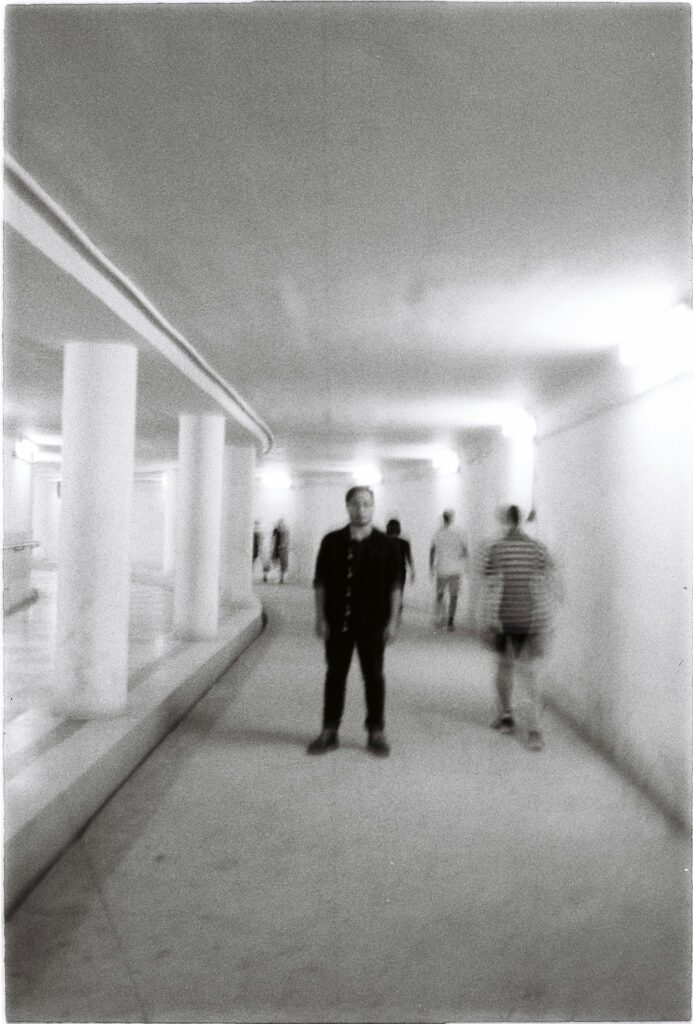
Not having always liked the sound of my own voice,1 I’ve never been one to rush forward when a speaker was required. In fact, it’s generally only when I’m still wondering who is going to volunteer that I realise that everyone else has taken one step back, leaving me designated as volunteer. You may think I should have worked out how to avoid being chosen, but in fact, by having had to face up to such situations on numerous occasions, I have gradually learnt how to speak in public, for better or for worse depending on circumstances.
It was only really when I became a language teacher that I began to realise the full extent of the reticence among students of all ages concerning public oral expression.2 Time passed and, as I accumulated experience in a wide range of different teaching contexts, I learned to like orality in general and doing oral activities in class. I discovered that there were umpteen ways of informing, surprising and entertaining an audience, while also learning how to stand, how to interpret reactions and look people in the eye. I also realised that when it comes to eliciting oral responses or initiatives from learners of whatever age that each individual must find his or her own path towards discovering his or her voice and then get other people to listen to listen to what they have to say – while also accepting the fact that some days that will be easier than others. That’s a lot for people to handle.
Which brings us back to the subject of what happened on the day when speech didn’t flow quite the way I had expected it to.
Just make a short introduction
Let’s pick up the thread and say something more specific about the day I lost it – the thread, I mean. What was the speech about? Nothing too complicated : giving a short introduction to an evening concert as part of a festival. Basically, this meant greeting everyone, readying them for the performance to come, telling them something about the artists, and finally inviting the audience to welcome them all on stage to thunderous applause.
Was I going to make this introduction by reading a pre-written text aloud? I wasn’t. Years spent teaching oral expression have convinced me that speaking in public without simply oralising a written text enables us to stay in the moment because nothing compares to going ‘live’. What was the plan? Well, not wanting to read something pre-written, I had the choice between total improvisation, or partial improvisation by oralising a prepared outline of a speech with room for variations. But whether you improvise or simply want to give the impression that you’re improvising, you need to think ahead. That means preparation.
Preparing to speak
I did some research on the artists I would have to present, then I listed these elements in an outline for my speech which I structured in skeleton form on a single sheet of paper. I simply needed to find a quiet moment prior to the show on the big day in order to use this outline to create an oral version of what I wanted to say.
This preparation ritual, which helps to put things in short-term oral memory, is adapted from the oral tradition and used by storytellers who need to refresh a narrative they haven’t used for some time before telling. Walking up and down, speaking or mumbling to myself in a low voice, I look for an oral version built from the outline of ideas which I have already listed. This doesn’t require silence – in fact a little background noise is good for covering up the sound of what I’m trying to say – but it is essential to be able to find the space and time to be able to carry out this brief preparatory monologue without being interrupted. The process is rather like that of a musician tuning an instrument, gently flexing before a performance and checking the smoothness of certain key passages in the piece to be played.

Manish Vyas from Unsplash
But on this particular day things happened differently. The time leading up to the concert was intense, particularly the final hour, due to a series of technical issues which triggered multiple exchanges between members of our team which, even though they had nothing to do with the presentation I was going to make, diverted my attention. It was impossible to find somewhere for me to focus and run through what I was going to say, and I began to feel the tension rising as the clock ticked towards showtime.
Ultimately, pretty much at the last minute, I found somewhere backstage between the performance area and the dressing rooms to work up my introduction. I managed to go through it from beginning to the end but somehow I didn’t feel convinced by the result. As mentioned earlier, I’ve been involved in oral expression in all its forms for a long time, but here I just couldn’t quite hear the music of the words sounding together in my head. But then it was time to start, and there was no time left to worry.
The name on the tip of the tongue
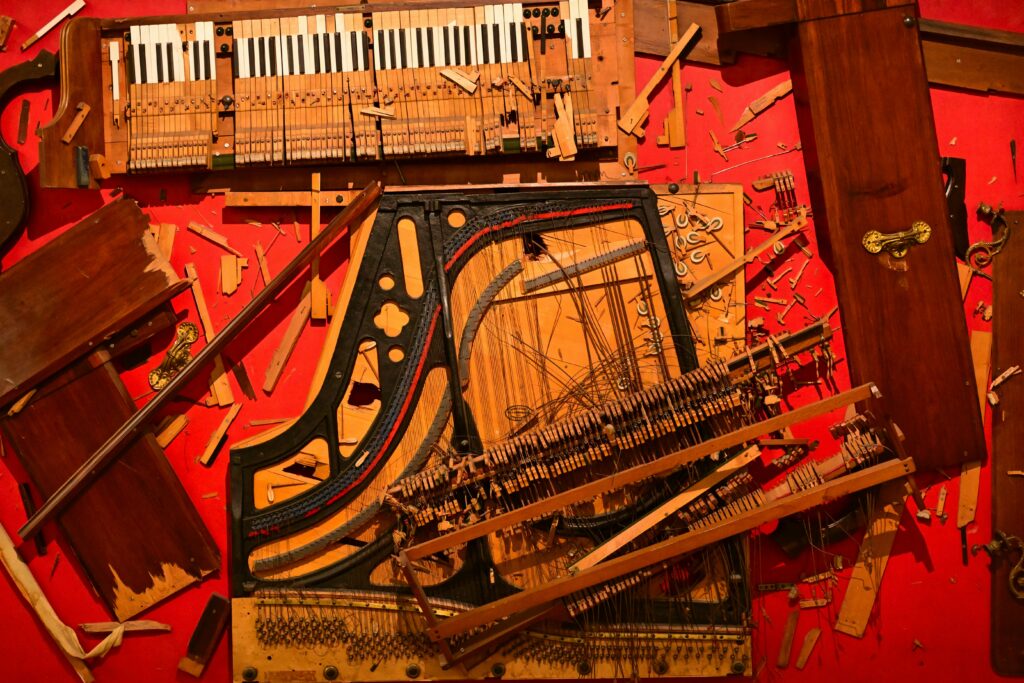
I said my piece. The beginning was fine and I began to feel confident but then, as I went on to tell the audience something about who they were going to see and wanted say the name of one of the performers, my memory failed me. I began looking for the name that I was going to say, that I wanted to say, that I had planned to say. The name was there, on the tip of my tongue, but just out of reach3. It felt like I had knocked over the name, scattering the letters on the floor, and was incapable of reassembling them in the right order. All this happened in a frozen moment of mental confusion which seemed to last for ever. At the time, I managed to fall on my feet, as any self-respecting speaker should when things go awry, and was able to carry on. How did I do that? Someone in the audience very kindly called out the name I was looking for, and I responded with something like : “Ah yes. I can see we certainly have some experts here toinght.”
Amin Zabardast from Unsplash
What happened then ? I had the name at last and could pick up my thread and continue. My presentation concerned a show with live music and dance but, as I moved on with my speech, I lost an important part of what I had planned to say – in particluar on the subject of the dancers who, consequently, were only mentioned briefly and in very general and partly inaccurate terms, unlike the musicians whose details came magically to mind with no difficulty whatsoever. Impossible to do better in the circumstances. Then it was over. The audience applauded, and what would be a great show could begin.
Understanding what went wrong
So there it was. Out of nowhere, for a moment, in front of an auditorium full of hundreds of people, I had stammered, spluttered, muttered, and lost my thread. A breeze of disorchestration had fragmented my thoughts, leaving me speechless. Gone with the wind all hope of dancing with the minds of my listeners. In spite of my best efforts to prepare myself, I had been caught in net of a speech disorchestrated. I survived, but I needed to understand what went wrong.
In her book on stuttering, Élisabeth Vincent explains : “Stuttering is never a constant feature of a person’s speech, it can occur at certain times and not at others. It is not an aticulatory incapacity but a disruption of coordination which disorchestrates speech.” 4 We can all stammer from time to time without being diagnosed as stammerers. There is no such thing as perfect speech, but we all fear its disorchestration when speaking in public because we say our words with our voice – and our voice is us, it is our identity.
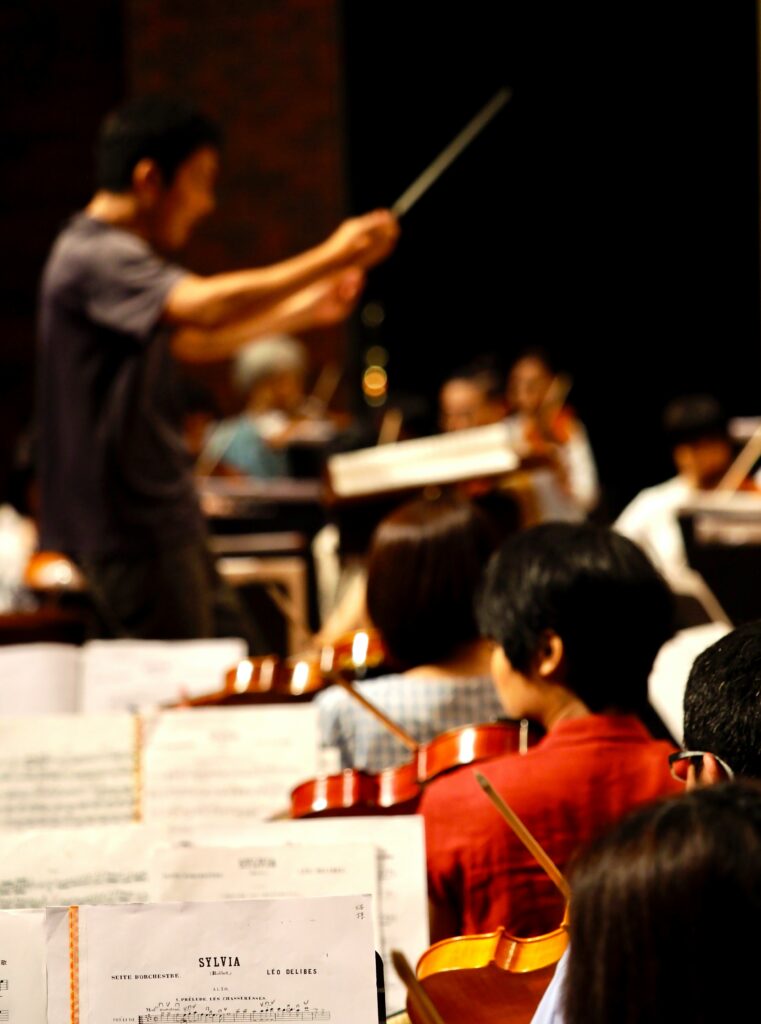
Élisabeth Vincent also reminds us that speech can be compromised when it is accompanied by mental hyper-activity : “People who stutter often say that their ideas go too fast to be verbalised or that they find it hard to find words to express their thoughts.” Perhaps my speech that day was too ambitious and, wanting too say too much, while also trying to keep everything in memory, words and thoughts simply collided. I can recall many other occasions where I have spoken perfectly adequately with no preparation whatsoever : as the words came, a sort of melody sounded from an invisible score which seemed to be composed as it was played in some strange sort of natural orchestration. That is what I should work from in the future.
Lastly, Vincent underlines the key-role which we attribute to our interlocutor or our audience when speaking. Any teacher knows that you have to be able to win over an audience who may initially not be even vaguely interested by the subject of a lesson. This forces us to work on how we announce what’s coming, how we capture attention, how we respond to the unexpected, and occasionally how we face up to working with any given group of students even on days when our own motivation level is low. If a teacher simply rolls out some sort of rehearsed speech as the lesson, we should not be surprised to find students’ attention and participation negatively affected. Yet, given the number of uncontrollable parameters in a classroom, some sort of preparation is necessary. There is a delicate balance to maintain, which is why teachers, like public speakers, need to be firm but flexible. Especially, says Vincent, on occasions when we are interrupted, lose our thread and need to go back and pick up what we planned to say : “Having to repeat something can put us in a particularly uncomfortable position. Saying the same thing over again while sensing the expectations of our interlocuteur can increase the tension we feel.” In my case, with my concert introduction, I was trying to find the name which eluded me and was saved by a supportive audience. Unfortunately, I completely forgot part of what I wanted to say next – probably because I wanted to show mastery which I no longer had, with the result that I just moved on too fast. During oral expression it is vital to have the intelligence to slow down in order to maintain intelligibilty.
Speech reorchestrated
I have had the chance to to do another similar presentation since the disorchestration incident described here, and it gave me the chance to put into practice certain principles which I hope to continue to be able to use wisely in the future :
1. Think in terms of something brief and punchy when introducing an event by focusing on essentials.
2. Don’t let yourself be held back by the written preparation and don’t let it invade the oral performance.
3. If there are things you can’t remember, then rephrase or simplify.
4. Don’t retreat or feel isolated if things get tough, reach out to your audience because you are part of that same community.
5. And remember to always, always have the intelligence to slow down in order to reduce tension and manitain intelligibility.
Applying these principles, I could feel a sense of speech reorchestrated. But I know from experience that, each time we speak in public, there’s a new challenge to meet with courage and creativity.
I wish us all good luck! In the meantime, let’s listen make sure we continue to listen closely, carefully, kindly, and occasionally critically to the public speakers whose words come to our ears. And remember to ask ourselves what we can learn from listening to them.
Still want more?
You will find a more developed practical example of how a storyteller can prepare an oral performance from a written outline HERE.
The fully updated selection of articles in the series Words tripping of the tongue can be found HERE.
Subscribe for news of posts as they are published.
- More on this topic in Why hearing your own voice is like looking at a selfie. ↩︎
- Examples of the things learners say about their reticence concerning public speaking can be found HERE. ↩︎
- The name on the tip of the tongue by French author Pascal Quignard tells a surprising tale about a forgotten name. Originally a narrative, in 2020 it was cleverly adapted for the stage in English as this review explains. ↩︎
- The original publication is only available in French. Le Bégaiement : La parole désorchestrée, Élisabeth Vincent, Éditions Milan, Les Essentiels Milan, 2004. ↩︎
Discover more from GERRY THE KENNY
Subscribe to get the latest posts sent to your email.




One Comment
Pingback: