-
The Room Next Door
Is there a door to death? Seeing the new Almodovar film about assisted dying sent me back to something I wrote down in answer to this question after seeing my mother for the last time. Quite a journey, but one which shows what happens when metaphors get real. Let me try and explain.
-
Songsmith Van Morrison And The Power Of Musical Resonance
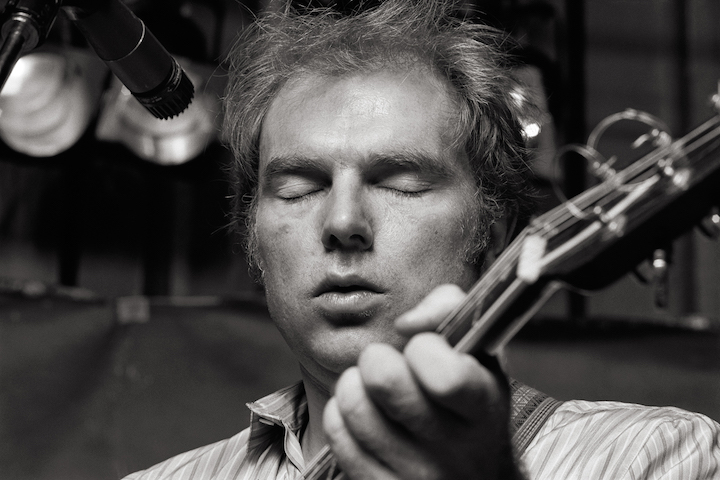
Van Morrison is a great explorer of the power of resonance and in "Listen to the Lion" he gives us a powerful example. It's basically a love song, but it explores territories which are older and deeper than most love songs. It still resonates with me years after first hearing it. Let me try and tell you why.
-
Vehicle of Change
My all time favorite automobile has to be a grey Morris Oxford Series II with red leather seats. It was our first family car which our dad turned up with one evening after work shortly before we moved house in the summer of 1964.
-
The rocky road to becoming a guitarist 2
This is Part 2 of the Learner Tale told by Chester Kamen, a musician mainly known as a rock guitarist, in which he reflects on how he learnt his craft. He walks us through the experience of being a self-taught musician in a competitive field where he met and worked with Bryan Ferry, David Gilmour and Madonna among others. He also reflects on his new life as a rock musician in a jazz context. A whole new challenge.
-
The rocky road to becoming a guitarist 1
The shortest path to becoming yourself is rarely a straight line, and learning to get there can take a lifetime. The Learner Tales series continues in conversation with guitarist Chester Kamen talking about how he learnt his craft and became a professional musician. He reflects on the learning path it takes to get to play with people like Bryan Ferry, David Gilmour and Madonna.
-
Astor Piazzolla’s Four Seasons of Buenos Aires
A number of composers have tried to put the seasons to music, so we can have them all year round. Antonio Vivaldi dominates the field with his Four Seasons from 1725. But since 1999, thanks to an arrangement for classical orchestra called Eight Seasons by Leonid Desyatnikov, a concert programme now alternates movements from The Four Seasons by Vivaldi and those by the Argentinian Astor Piazzolla from his tango suite The Four Seasons of Buenos Aires, also known as Cuatro Estaciones Porteñas. Let's take Piazzolla out from the shadow of Vivaldi by taking a closer look at his Four Seasons of Buenos Aires.
-
Sporting confrontations : war minus the shooting?
This next travel tale has a sporting flavour. A fight on a station platform at Greenwich between rival football supporters recalls George Orwell's connection between sport and war. What can this fight tell us about territory, identity and the sense of belonging in these war-driven times?
-
The art of people-watching
People-watching requires no specific qualifications, just a little time and the curiosity to do something other than scrolling through irrelevant notifications on your phone. This means that, instead of looking down, you look up. What may turn up in our immediate environment has not been chosen by an algorithm. At least, not yet. This next piece in this scrapbook of travel tales is about a people-watching experience et Gatwick Airport.
-
Slowly Bringing The Map To Life
This could be the start of a scrapbook made of moments in transit. When I return to a place I've not been for some time, a narrative gets triggered by an inner voice. Sometimes it is simply a string of words spun out of the sights, sounds, smells, textures hiding unseen around me. I write down these scraps as best I can. Some get reshaped and these can be shared.
-
The usefulness factor
Learning can be a mysterious process. If you like mysteries, try this for size. How does somebody who sets out to be a journalist start by studying political science and law, then finally end up happily working as an urban planner? Only Alice Pfeiffer's Learner Tale can give you the answer.