CLIQUEZ ICI POUR LIRE CET ARTICLE EN FRANCAIS
Tell me, Muse, the story of that resourceful man who was driven to wander far and wide after he had sacked the holy citadel of Troy. He saw the cities of many people and he learnt their ways. He suffered great anguish on the high seas in his struggles to preserve his life and bring his comrades home. But he failed to save those comrades, in spite of all his efforts. It was their own transgression that brought them to their doom, for in their folly they devoured the oxen of Hyperion the Sun-god and he saw to it that they would never return. Tell us this story, goddess daughter of Zeus, beginning at whatever point you will.
The Invocation of the Muse, Book I, Homer’s Odyssey, translated by E.V. Rieu, 1957, revised by D.C.H. Rieu
Our connection with Odysseus is still intact
There are stories which leave a life-long imprint on us from an early age, and others which wait patiently until we are old enough to come to them. The Odyssey fits into both these categories and, in many ways, tells more than its own story. It is justly celebrated as being the template for many other narratives in forms as diverse as literature, painting, sculpture, film, the graphic novel and video games.
Among these appropriations of The Odyssey over the years, the list of translations is truly impressive, and each translator manages to take ownership of the same story.
Just look at the different perspective on Odysseus given in the opening lines. In The Invocation of the Muse quoted above, Odysseus is that resourceful man. In another translation, he will be the man of many ways1, another will prefer the man of twists and turns2, yet another will present him as the many-sided hero.3
Radically different, a recent, influential translation has him as a complicated man4. It is true that today, for things we cannot or do not always want to explain, complicated is often the word we reach for – a word which does the job without explaining all the details, a word of many ways, full of twists and turns, a resourceful, many-sided word, and proof that the connection between ourselves and Homer‘s hero is still intact.
Listeners, readers and spectators – Homer makes us all of these
Welcome to the latest article in Foreign Affairs which is the section of this blog where the focus is on the experience of being a foreigner and its influence on how we see the world. The current article was triggered by the July release of Christopher Nolan‘s new screen adaptation of The Odyssey, a film which has put foreign travel, adventure and multiple identity firmly back into the public imagination.
Nolan‘s almost 3-hour adaptation with Matt Damon as Odysseus has been a commercial success but has raised questions. Is too short or too long? Are certain narrative liberties taken over the order of episodes justified? Is too much space given to modernising points of view and attitudes in the story? Can a creative film-maker be true to Homer or not?
There’s only so much you can put into a screen version of such a vast range of content. Nolan’s film is packed full of events, of course, and although overly noisy at times, constantly holds our attention. Perhaps it is the pull of the narrative which comes from knowing there was still more to come – the Cyclops and that mysterious single eye, the wind games played by Aeolus , the magic of Circe, the song of the Sirens, the years Odysseus spends with Calypso and so on – and wondering how certain sequences would unfold. It remains an irresistible story to which we can just as easily be be readers, listeners or spectators.
The pleasures of rediscovery
How do we get such pleasure from rediscovering a story we already know? That sense of anticipation has always been a key part of the oral tradition of storytelling which in turn is part of something even bigger : Oral tradition refers to the practice of passing down cultural legacies, history, and knowledge through spoken word… Storytellers are key figures in this tradition, using techniques that include improvisation and the incorporation of stock phrases to engage audiences and enhance memorability.5
Tellers in the oral tradition have no problem with the audience knowing the story already – just look at all the spoilers in that opening passage from The Odyssey quoted above – because what matters to the listeners is not the events themselves so much as how the storyteller is going to relate them.
In the case of The Odyssey, authorship is attributed to Homer, a person we know very little about. He may have been either a man, a woman or a group of poets – as this British Museum article outlines. The text we now possess is believed to have come from the 8th or the 7th century BC, while the stories Homer tells find their original source in the oral tradition. So The Odyssey itself is a retelling based on much older material.
The traveller’s return
So why put this post in Foreign Affairs? Because Odysseus is a traveller, and travel changes both the perception we have of ourselves and the way we are perceived by others.
We leave as natives of one country but return as something different. The new-found ability which helped us to blend in or even become invisible in foreign places, can make us unrecognisable to those who knew us before we left – even old friends and family. This cloak of invisibility can complicate and colour our own identity to the point where, for others, we no longer stand out as ourselves. This means going home can be a complicated story.

Nothing new in that, of course. It is even older than Homer, but he uses it neatly when he tells us of Odysseus, King of Ithaca, who returns to his island after 20 years of absence. News of his return is, of course, desperately awaited by his wife Penelope, his son Telemachus, and a group of those who have remained true to him. On the other hand, proof of his death is just as eagerly awaited by the prentenders invading Penelope‘s life as they dream of accession to what they see as a vacant throne.
With the help of Athena, Odyssesus pretends he is someone else. Nobody special. A beggar. Something he has learnt to do in his adventures. This disguise is the hiding place from which he will ultimately spring, when the moment is right, to wreak vengeance and reveal himself, not as the king he was, but the resourceful, many-sided, complicated man of twists and turns he has become.
Homer‘s telling is masterful, and Nolan serves him well. So if you haven’t seen the movie, then give it a chance. But if you haven’t read Homer‘s version, what are you waiting for?
Indefinitely multiple
Personally, seeing the new screen adaptation made me want to pull my copy of The Odyssey from the shelf again. It was the Penguin Classics translation by E.V. Rieu where I first read the epic in full.
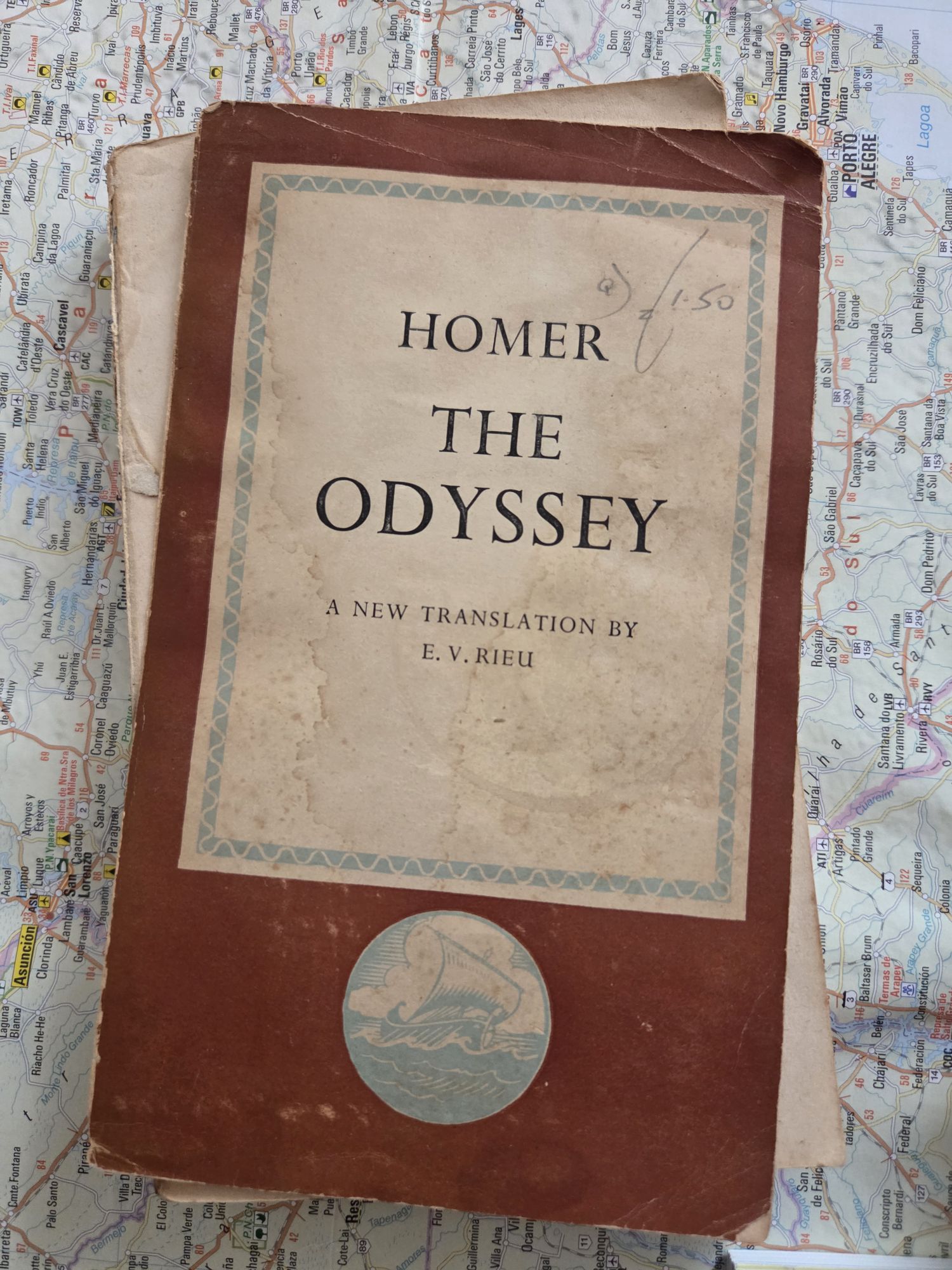
I’d opened the book multiple times before, not just to read and re-read certain episodes, but also to leaf through the pages the way you go back to revisit a familiar place or at least see pictures of it. Tucked in between the pages, I found something forgotten inserted there a while ago : a series of passport photos wrapped in parchment paper. I put them there because I find that books are good places for keeping things safe – providing you can remember which book you put them in when you need to retrieve them, which in this case I hadn’t.
Pulling out the little packet, I gave it closer examination. Written in pen by a firm hand on the outside of the protective wrapping was a list of sorts, starting with the sequence B1-2, which I took to be some sort of administrative code. Beneath that was the date 17 / Nov / 1967 written – why was I noticing this now? – without the horizontal bar to the 7, the sign of an Anglo-Saxon hand. Under these was the number N° 109528 and, at the bottom, the words indefinitely multiple. This final formula suddenly struck me by its ambiguity : did it refer to the multiple copies of the same passport photo, or to Homer‘s man of many ways?
A little research revealed that B1-2 and indefinitely multiple can be sourced. Up to 1994, regular travellers to the USA could be assisited in gaining time with visa requests by being given a permanent visa which lasted as long as their passport was valid. Renewal was a formality to be completed every 10 years.
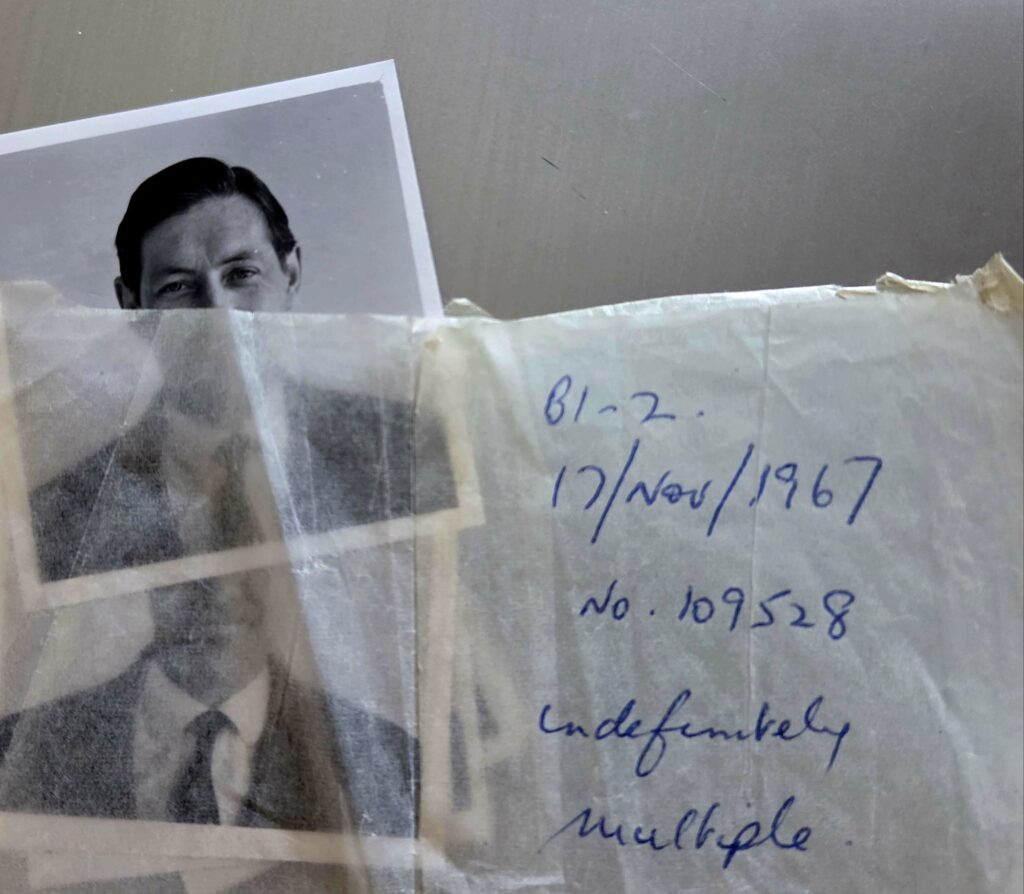
Back then, the visa in question was valid indefinitely for multiple applications by the American authorities, giving the holder the right to enter the country for temporary stays for professional (B1) or personal reasons (B2). So the photos seemed to be part of an application for a permanent US entry visa. 17 November 1967 could be the date the application was made or, more probably, the expiry date for passport N° 109528.6
Of course, this information confirmed my misreading of indefinitely multiple as being two words composing one idea and not individual words referring to two aspects of an administrative procedure. And yet, tpgether the made a new translation of Homer‘s term for the traveller returning to his island : the indefinitely multiple man from a story as old as the oral tradition handed down in indefinitely multiple versions. It also fitted as a name for that valuable life-skill which living out new experiences, being seen differently by others, learning to cope outside our comfort zone in foreign places.
J’ai reconnu l’écriture sur la pochette, tout comme le visage sur les photos. Comme tous les pères, le nôtre était complexe, mais il pouvait parfois être compliqué aussi. Un trait nouveau, non seulement le concernant, mais concernant également nous tous et toutes, émerge ici. Grâce à cette pochette confiée à la protection d’un livre, avec l’aide d’Homère, du film de Christopher Nolan et peut-être un coup de coude de la part James Joyce et son épopée gréco-irlandaise jamais très loin, on peut affirmer que toute histoire, comme toute traduction, tout voyageur et tout individu, aussi singuliers qu’ils soient, restent et resteront indéfiniment multiples.
I recognised the handwriting on the parchment, just as I did the face in the photographs. Like all fathers, ours was complex and could also be complicated. However, a new feature, not only in him, but in all of us, emerged here. Thanks to a small packet entrusted to the safe keeping of a book, with a little help from Homer, Christopher Nolan and perhaps an inkling of James Joyce‘s Greek Irish epic lingering in the background, we can say that any story, any translation, any traveller and any individual, whatever its singularity, is and remains indefinitely multiple.
As I wrapped up the photos in their parchment paper once more, tucking them into the pages of the book and placing the book back on the shelf where evrything suddenly seemed to have fallen into place, I heard a voice singing :
Tell us this story, goddess daughter of Zeus, beginning at whatever point you will.
Now it’s done.
NOTES

You May Also Like

Accepting the sweet song of a foreign language

English father tongue